Youth Food Justice Taskforce to kickoff Food Justice Fridays at CCC

February 29, 2012

Youth FJTF Coordinator Anthony Grimmett with Policy Link
DETROIT – The Detroit Youth Food Justice Taskforce will be hosting their first Food Justice Friday Community Dinner on March 2 beginning at 6 pm at the Cass Corridor Commons. The Youth FJTF will be joined at the community dinner by Peoples Kitchen Detroit who will cater the event and join with community members in attendance to discuss food justice issues in the city.

“The initial idea was to create a high energy, youth-centric, art-filled environment in which youth can learn about Food Justice and be inspired to become active in creating a movement and\or just share what they know with their peers,” said EMEAC's Sanaa Nia Joy. “The main goal of the event is to share information on Food Justice with the community, and to use art and media in an interactive way that transforms attitudes, thought and action in hopes that people, especially young people,will be more mindful of what they eat and possibly even demand healthier food thereby bringing change to a skewed food system.”

Youth from programs at EarthWorks, Greening of Detroit, Feedom Freedom and other food/growing based organizations have been invited as members of the Youth Food Justice Task Force. The plan is to have similar type forums at various organizations' space as a monthly event. Youth from any organization or individuals brought by their parent are welcome. Event planners expect about 50 people to attend.

Angela Newsom
The Youth Food Justice Task Force was created by the Detroit Food Justice Task Force, of which People's Community Kitchen is a member. The idea of a sharing a meal as a way to build community is a tactic used successfully by the Food Justice Task Force last year. Angela Newsom of People's Community Kitchen will work with the Youth FJTF to prepare and serve a meal to the community for the event.

“As a member of the Cass Corridor Commons and Detroit Food Justice Task Force, People's Kitchen Detroit is inspired and encouraged by youth participation in this event,” said PKD's Angela Newsom. “They are really leading the event and making it their own. For there to be sustainable, life-altering change in the city with regard to food access and affordability, the young people are vital to making that happen.”

Members of the Youth FJTF will also be traveling to Oakland, California March 7-10 for the SOUL National Youth Organizing Training Institute. The INSTITUTE 2012 is a 3-day national training for young organizers, young member leaders, and youth organizers from across the country.

Participants will come together to build their skills, exchange lessons learned, and strategize to fight to win justice for our communities. They'll develop a solid and systematic orientation to the fundamentals of organizing, including base-building, campaign strategy, and leadership development. Rooted in current youth struggles, the INSTITUTE will provide a unique space for emerging leaders to engage with the challenges and opportunities of the current moment, to advance our organizations and to build a stronger movement.

“Because it's Oakland, it's kind of like Detroit. They do a lot of work around environmental justice and they are real die-hard about it,” said Youth FJTF Coordinator Anthony Grimmett. “That's something I'm definitely looking forward to and meeting new people and some of the projects they are working on. For us, it's about development, so I'm definitely looking forward to getting some ideas that we can bring back to Detroit to share. For our report-back, I'm definitely looking for things that I can draw. I'm going to bring my artistic eye as well. We'll be looking for some different concepts as well.”


YEA joins DWEJ to present at High School Social Justice Forum in Windsor

Siwatu-Salama Ra gives presentation on campaign building
WINDSOR, Canada – EMEAC's Young Educators Alliance (YEA) Team joined with Detroiters Working for Environmental Justice (DWEJ) to give a series of workshop presentations at the Sixth Annual High School Social Justice Forum held at the University of Windsor on February 21 in Windsor, Canada.

YEA attended the Social Justice Forum at the invitation of DWEJ's Charles Stokes and were accompanied on the trip by EMEAC Associate Director Ahmina Maxey and DWEJ, Chief Executive Officer Guy Williams. YEA Team members making the trip were Siwatu-Salama Ra, Rayven Roberts, Sabrin Salam, Anthony Grimmett, Roger Boyd, Noelle Frye, Paris Smith, Elayne Elliot and Malik Harris.

YEA Team Members during panel discussion
“There was a request for youth to attend and elaborate on environmental justice inside the city of detroit from a young person's point of view,” said Siwatu, who is EMEAC's Stand Up Speak Out (SUSO) Program Youth Leader. “Charles Stokes was already aware of the Feed1 Teach1 event that YEA kicked off in mid-December along with checking out EMEAC's website and was impressed of what YEA is doing and asked that YEA facilitate a workshop and panel at the Forum. This was an opportunity for YEA to go international and we were all very appreciative of the invitation.”

Roger Boyd documents the trip
The Forum was filled with approximately 300 excited Canadian high school students. There were 16 workshops held during the event and every student was assigned to two of the16 workshops. Some of the workshops were on: Criminalization of Migrants vs. the right of freedom of movement, Hip Hop, prison and the many facets of racism in the justice system, the Lesbian Gay Bisexual Transgender Queer community and the environmental justice workshop presented by the Detroit delegation
During the EJ101 workshop, Williams introduced the space with EJ 101. He was then followed by Siwatu who facilitated a workshop on "How to create an organizing campaign.

Maxey then introduced the YEA team and conducted the youth panel discussion with questions like; “How has being involved in the EJ movement and apart of YEA changed you or help you grow?”
“It was actually really fun,” said Grimmett who like many of his fellow YEA Team members was making his first trip across the border to Canada. “When we broke into groups, that's when YEA along with Guy Williams of DWEJ did a presentation in the workshops that we were in. He basically introduced us and said, 'I'm here with EMEAC and some partners.

“Siwatu got up and did her workshop on campaign building. That actually went really well. I was kind of nervous at first, but seeing her go in so calm, let me know it was going to be all right. We then introduced ourselves and we did our panel discussion. They asked us questions and we answered them.
They asked us about our growth and about being in YEA.”

After a break for lunch, the Detroit delegation engaged in another round of workshops and presentations with the next set of students. Out of the experience, team members welcomed the opportunity to share their work and network with young people and activists on the Canadian side of the border.

“There was a lady on campus who was involved with their on campus community gardens. She introduced herself to us because I had mentioned doing food justice work and how environmental justice plays into what we do,” said Grimmett who also has a lead role on EMEAC's Youth Food Justice Taskforce. “We talked about some of our achievements like the Cass Park clean up, working with ReMedia, the North End Garden and Feed1 Teach1. We exchanged cards so we could link up later and work together around food justice. It's just networking and maybe we can get together to do some work through social networking.”
“It definitely was a good experience being around another crowd and having to speak in front of them. It was a majority white environment and we were the center of attention. At the end of the day, they were going to come out with some useful and positive information.”

The YEA team also did live tweeting via their Twitter accounts at the event. If you would like to follow the tweets from the forum go to http://socialjustice.govital.net/ or search for the Twitter hash tags #Sjforum2012 or #detroitfuture.


“Shout outs to YEA and how appreciative Canada was for them participating,” Siwatu said. “YEA now has enhanced identification and can visit again. I'm glad we attended the forum. The most rewarding thing to me was that YEA has made it International and was able to reach out to young people across border.

“It was rewarding to know that we were the first American people to attend their Forum. Acknowledging us in front of the whole conference was uplifting! There were many connections that were made to further the conversation and working together is always rewarding. YEA got another opportunity at enhancing their speaking skills and creating their signature YEA workshops. This was definitely a reward in action and just stay tuned for YEA's next steps.”


Reminders of the risks of nuclear power come from past/present, near/far

This is the latest in a series of columns discussing the Environmental Justice Principles drafted and adopted by delegates to the First National People of Color Environmental Leadership Summit held Oct. 24-27, 1991. This week, we’re continuing our discussion of EJ Principle number four: Environmental justice calls for universal protection from nuclear testing, extraction, production and disposal of toxic/hazardous wastes and poisons and nuclear testing that threaten the fundamental right to clean air, land, water and food.

Fermi 2 Nuclear Power Plant in Newport, Michigan

As we come up on the one-year anniversary of the Fukushima Dai-ichi nuclear disaster in Japan, reports are still emerging about the way the Japanese government kept critical information from their own public in the wake of one of the worst nuclear catastrophe's the world has ever seen. Likewise with three nuclear sites in the state of Michigan, we should also keep in mind other reminders about the potentially grave risks inherent to nuclear facilities closer to home. 

On the March 11 anniversary of the Fukushima melt down, there will be a special screening of the anti-nuclear film “Into Enternity” at the Unity Church of Livonia beginning at 7:30 p.m. The film will focus on the environmental delimas surrounding disposal of nuclear waste materials, and give an update the proposed Fermi 3 nuclear plant, the world's largest Fukushima styled reactor. 

There are currently three nuclear power facilities in the state: Cook in Bridgman, Palisades in South Haven and Fermi in Newport – just 40 miles south of Detroit. All three power plants are located in southern Michigan along the shores of the Great Lakes, and provide 27 percent of the state's energy.
As we all saw last year with Fukushima, all nuclear plants have to be located near large bodies of water because water plays a key role in both the production and containment of nuclear energy. Michigan's location in the heart of the Great Lakes region means the old NIMBY (Not In My Backyard) game of environmental injustice is one Metro Detroiters should not lose sight of. Just ask the residents of another of the world's great cities, Tokyo. 

Of course, Detroit's nuclear safety concerns are helped by the fact that the region doesn't sit on one of the world's most active seismic regions like Japan, but any one who knows the history of the nuclear industry in Michigan can tell you that's no invitation to sleep on the issue. On October 5, 1966 the Fermi 1 reactor suffered a partial meltdown caused by a blockage in one of its spigots. The blockage caused an insufficient amount of coolant to enter and the problem went unnoticed by plant operators until some of the plants fuel rods reached 700 degrees causing them to melt. 

Thankfully the plants alarms kicked in to prevent a complete meltdown but the incident should serve as a reminder that vigilance is always warranted when it comes to nuclear power. Fermi 1, named for nuclear physicist Enrico Fermi, who worked on the development of the world's first atomic bomb and later became a pioneer of nuclear energy, was eventually shutdown in 1972. 

Its successor, Fermi 2, came online in 1988, and despite a brush with a tornado in 2010 that caused damage to the facility, it remains online. That incident should be kept in mind however, as warmer winters and the subsequent increased tornado activity could be the biggest natural threat to nuclear facilities in many parts of the country. 

The Fermi plant is owned by DTE Energy and maintained by the Detroit Edison Company. DTE filed an application to build a third reactor, Fermi 3, at a cost of $10 billion in 2008, but have been thwarted so far by the efforts of local citizens on the basis that it would threaten Lake Erie. Somehow, I'm betting that we've not heard the end of this story. 

Meanwhile on the western side of the state's southern shoreline there have been even more recent developments. Earlier this month, the Palisades nuclear power plant received a downgrade of its facility from federal regulators as a Valentines Day present. The heartfelt gift put Palisades in the company of only two other plants in the country. 

According to an Associated Press report by their environmental writer John Flesher, “The Nuclear Regulatory Commission assigns the more than 100 nuclear reactors in the U.S. to one of five categories based on their safety performance. Most are in the top-performing group. Palisades was bumped to the No. 2 category last month and now will join two others in the third category.”

There's only one other reactor in the country with a lower rating: the Brown's Ferry unit in Athens, Georgia. It stands alone with that distinction. 

There were two violations that led to the downgrade at Palisades. One was on Sept. 25 of last year when an electrical fault caused by plant workers led to the reactor and half of the control room indicators to shut down. According to NRC report, this triggered safety systems that actual plant conditions did not justify. Agency investigators went on to described the incident as having “substantial safety significance.”

The other violation was the failure of a water pump that cools safety equipment. The pumps failure resulted from cracking of one of the couplings that hold together rods in the cooling system. The same failure had happened in 2009, and the commission said an inspection showed the plant hadn’t done enough to prevent a recurrence. The NRC has scheduled a public hearing on the matter for February 29 in South Haven. 

So as we gear up to remember what happened in Japan over a year ago, let's remember to keep our eyes and ears open here at home.

EMEAC’s Stand Up! Speak Out! Program having Mom-2-Mom Fundraiser & Bake Sale March 24 at CCC

DETROIT -- A Mom-2-Mom Charity Sale & Bake Sale will be held March 24 from 9:30 am to 12:30 p.m. in Mid-town Detroit's Cass Corridor Commons – the new home of East Michigan Environmental Action Council (EMEAC) at 4605 Cass Avenue, inside the First Unitarian Universalist Church. www.emeac.org

This re-sale is a fun event where families can make money, save money, re-use and recycle the items they’ve already spent hard-earned dollars on. It’s win, win win!” said EMEAC Policy Coordinator Alisha Deen-Steinder.

A Mom-2-Mom sale is like a large flea-market or indoor garage-sale where anyone can sell gently used children’s & teen items from their home. Shoppers pay only a $1 entrance fee and can browse through hundreds of used items at garage-sale prices. There will be 30-35 tables with children’s items. Clothes sizes will be from infant all the way up to teen. Large items like strollers and kid’s bicycles are also welcome.  Delicious baked goods and coffee will be available also.  Proceeds go to support EMEAC's Stand Up Speak Out (SUSO) programming.

We are also going to have the Young Educators Alliance. Some of them are going to be selling their items, so teens are definitely welcome,” said EMEAC SUSO Youth Coordinator William Copeland. “Right now we get a lot of funding from grant sources, which are great, but we want to start doing more independent fundraisers to help support our Young Educators Alliance, our in school programs and for the policy work that we do.”

It costs $20 to rent a table to sell items. Anyone interested is encouraged to beat the crowd and arrive early for the $2 Early-Bird special from 8:30-9:30 a.m. Beginning at 9:30, the doors officially open at the $1 entrance fee.

The Mom2Mom Sale concept has taken off in churches and schools every Saturday morning all around the Detroit-Metro area, but very few such sales have been located in Detroit. This is a great way for to keep money in the community.

Full-priced children’s clothes, shoes, toys, games can cost a fortune, and it’s nice to have a one-stop place to get cheap, quality used clothing for my family.” A Royal Oak mother of two said.

Contact Alisha Deen-Steindler at 248-269-3662 or Alisha@emeac.org to reserve a $20 table.


Who do the proceeds of the sale go to?

Stand Up! Speak Out!

Stand Up! Speak Out! (SUSO) is the advocacy arm of the East Michigan Environmental Action Council.  SUSO programs and activities advocate for environmental justice in Southeast Michigan through legislative policy initiatives while encouraging community involvement through youth and adult education and training.

SUSO is also home to the Young Educators Alliance a small group of young adults (aged 14-24) who come together to identify issues in their environment and work collectively on solutions, using their creativity and personal insight.  YEA advocates for healthy environments in Detroit in a way that fosters leadership and holistic development.  Young people learn to identify injustices, place them in a historical context, and propose alternatives that involve community input, community organizing, and/or advocacy. The program aims to build a “pipeline for community activism” in which young people come to see themselves as community activists and learn to network and engage with existing communities of activists.  SUSO also partners with EMEAC’s ReMedia and Greener Schools programs to conduct environmental education classes and trainings in Detroit schools for students in grades 6-12.

EMEAC Supports State-Level Anti-Idling Legislation

DETROIT -- EMEAC sent in a letter of support for Senator Hoon-Yung Hopgood’s statewide Anti-Idling Legislation, SB 819 & SB 820.

Detroit was instrumental in laying the groundwork for anti-idling policy in the state. The City of Detroit was one of only three cities in Michigan to already have local laws on the books regarding anti-idling.

The EMEAC Policy Team worked very hard to get an Anti-Idling ordinance at the city level passed in Detroit (2010) and continues to make sure that the ordinance is enforced. After being involved in discussions around these bills at the City of Detroit Anti-Idling Workgroup, the Policy Team felt supporting the statewide initiative was the next logical step. To date, twenty states have enacted similar anti-idling legislation.

We have been working with Hopgood's staff to incorporate Detroit-specific issues and to make sure the bill is similar to our citywide ordinance.” Said Policy Coordinator, Alisha Deen-Steindler. For the most part, EMEAC’s suggested amendments and concerns were all taken into consideration and reflected in the latest draft of the bill.

What the Bill Would Do:

SB 819 & 820, introduced by Sen. Hoon-Yung Hopgood (D) on November 10, 2011, would prohibit heavy diesel trucks (over 8,500 pounds) from idling more than five minutes within a one hour period, or 15 minutes for loaded buses (or 30 minutes for ones waiting to unload), with certain exceptions for emergency, health and safety, inspection, maintenance and other necessary purposes. Drivers and truck owners are subject to fines of up to $500. The fine revenue would go to local governments. Also, SB 820 spells out how the measure could be enforced by local volunteer “parking officers”.

Enacting a statewide idling policy will improve air quality and make for a cleaner environment by reducing emissions, will help businesses cut costs associated with wasted fuel and unnecessary engine wear and tear, and will improve government efficiency by creating a streamlined regulatory structure,” said Senator Hopgood.


5E/Heru celebrate building reopening by hosting January DFY gathering

Tanesha Fashion performs "It's Me"
DETROIT – The 5 Elements Gallery and the Heru Organization were joined by the rest of the Detroit Future Youth (DFY) groups in celebrating the reopening of their non-profit visual art and hip-hop culture gallery on January 28 in Detroit's historic Corktown District. Approximately 70 community members from the 12 DFY member organizations and their supporters turned out for the event which featured workshops centered around 5E/Heru's seven power principles, performing arts, hip hop fashion exhibits and a special meal prepared by local family-owned caterer Sunflower Mama.
“We now have our building back to do our programming in a consistent space,” said 5E's Piper Carter. “We had been like nomads bringing our technology and learning into various environments, which was great as far as exposure for ourselves and our youth. Now we will have a space they can call their own, and they are very excited about helping take care of the building as well as continuing the workshops and field trips.”
DJ Sicari Ware turns over the wheels of steele to 5E Youth
The 5E Gallery was founded by Detroit Disc Jockey Sicari Ware in 2008 as a creative outlet for the city's art and music communities. Its mission is to increase public awareness and appreciation of Detroit's contemporary visual arts and music communities through exhibitions and educational programs. 5E and The Heru work collaboratively to support and mentor young up-and-coming local artists.
The groups believe that contemporary art and Hip Hop transcend international boundaries and involve all forms of visual expression, including painting, sculpture, drawings, prints, illustrated books, photography, architecture, design, film and video. They also embrace new art forms, which reflect and explore the artistic issues of today, but are yet to be developed or understood.
“It was awesome to see the 5 Elements Gallery space open again,” said DFY Coordinator Alia-Harvey Quinn. “5 Elements Gallery has been a partner on the deepest level, before the Detroit Future work even formally began. As a member of the Detroit Digital Justice Coalition, 5 Elements Gallery helped create the vision for this work. It has been an honor to support them and the work they do with young people.”
DFY Youth discuss principles during a breakout session
Following an opening reception catered by Akila Muhammad's Sunflower Mama's Vegan Catering featuring locally grown organic food, the gathering broke out into workshops to discuss each of the groups' seven power principles. Those principles are: cultivating self knowledge and awareness, recognizing self as the beginning of community, deliberately practicing positive and productive expressions, respecting organic learning and all intelligence, positively creating reality to empower others, nurturingly inspiring accountability, and growing substantial infrastructure to help the community flourish.
The gathering then reconvened to creatively share their reflections on the principles. The innovative ways of presenting those reflections ranged from call-and-response, to skits, to improvised rhyme saying. That was followed by a presentation on collaborative economics by Detroit Future's Jaun Martinez, who is also a member of the Beehive Collective. Cooperative economics is one of the core principles shared by DFY, 5E and The Heru. As part of the DFY Collective the groups have been partnering to develop cooperative economic models developed by area youth.
“It was informative, interactive, completely in line with our principles as well as the principles of the Detroit Future Collective,” said Carter. “It was fun for all.”
The fun didn't stop there as the event was highlighted by a non-stop fashion show accompanied by DJ Sicari's music with 5E/Heru artists King Kold, Taneesha Fashion, Bryce Anderson-Smalls and Kadiri “Sirius” Dobey taking the mic. King Kold performed “Let 'em Know.” Young Teneesha stole the show with her performance of “It's Me,” and Bryce and Kadiri brought down the house with a new version of their food justice anthem “Bootleg Food.”
5E member struts his stuff during fashion show
“As far as 5E/Heru we are structuring our programming more,” Carter said. “We will have slightly more formal skill learning with regard to media creation, software, principle building, media literacy, constructing messages, building issue based campaigns, refining media skills, critiquing our work, researching facts, etc. Our way is more organic and we will continue with this organic style of facilitating as well as include a consistent time for structured learning activities.”
The January gathering marked a milestone in the progress of the DFY Network. Coordinators said they are looking forward to deepening the work of the network for the remainder of the programs funding cycle.
“One of the overarching goals of Detroit Future Youth is to facilitate deepened relationships among the partners,” Harvey-Quinn said. “We do this largely through gatherings, which are hosted on a rotating basis by one of the partnering organizations and attended by all the other organizations. I think this gathering proved that relationships are deepening.
“It was great to see youth from different organizations, backgrounds, neighborhoods, and ethnicities dancing and having fun together. And for Detroit Future Youth, working to deepen relationships is not just about creating feel-good-moments; we work to deepen relationships to increase our capacity and sustainability. At the end of this 16 month funding period, because of the time spent together, these groups should be comfortable attending each others workshops, sharing curriculum, partnering, asking for support and offering support. Facilitating deepened relationships means that our work will continue even if funding is unavailable.”
For more information on the groups involved in this event visit: 5egallery.org, theheru.org, detroitmuralfactory.com or youth.detroitfuture.org or Sunflower Mama at http://www.facebook.com/pages/SunflowerMamas-Vegan-catering-and-Gluten-free-soups/375886795760794?ref=ts&sk=wall.

Whole Note Healing Collective a work in progress at CCC


Photo by Metal Mountain Arts
DETROIT -- The Whole Note Healing Collective is a cooperative community space organized by activists, healers, health practitioners and health and healing justice organizers. The collective includes leaders and advocates in Yoga, Reiki, Acudetox (Ear Acupuncture), Eco-psychology, Massage, Full Spectrum Reproductive Services, Belly Dance, Conflict Resolution and more. All members of this diverse group have multiple skills, offered as gifts to the community at large and are leaders in their own right.

Whole Note is a work in progress (and always will be). Currently, they are doing extensive research on health & healing initiatives around the country and gathering information on principles, guidelines, and operating procedures. All recommendations are welcome. In the meantime, Whole Note is working on designating space at the Cass Corridor Community Commons (C3) and offering select services.

Services available
Reiki

Reiki is a Japanese technique for stress reduction and relaxation that also promotes healing. It is administered by "laying on hands" and is based on the idea that a "life force energy" flows through us and is what causes us to be alive. If one's "life force energy" is low, then we are more likely to get sick or feel stress, and if it is high, we are more capable of being happy and healthy.

Reiki was rediscovered by a Japanese man, Dr. Mikai Usui. Its history is ancient and the concepts are present in several cultures.

While individual treatments will always be available, Whole Note will also be offering group Reiki healing in a shared, community space. Reiki Thursdays will be a collective healing space because we are inspired to heal together. Reiki Thursdays will be offered in one large room with individual treatment areas set-up for separate treatments. Stay tuned for more information.
Individual or group Reiki treatments can be scheduled by emailing: Reikithursdays@gmail.com.
Healing Belly Dance

Belly Dance classes are offered on Monday, Friday and Saturday. They are taught with a focus on empowering women (and others) to connect with their brightest self. Basic Belly Dance techniques are taught by using North African rhythms and encourage participants to accept their bodies just as they are. Belly Dance is for every woman's/person’s body.
For more information, contact Sanaa at thehealingbellydancer@yahoo.com 313.478.3920.

Update and Upcoming

The Good Vibrations Wellness Fair and Fundraiser has been postponed until April. Plans are underway for a city-wide fast and holistic health fair fundraiser. As details for this event and others become available, they will be posted in Whole Note’s calendar: http://wholenotehealing.wordpress.com/.


DFY Reimagines Leadership at Detroit Future in December

January 25, 2012

Examples of Emergence
DETROIT -- Organizations and community members from across Detroit came together on Saturday December 10th for a day of discussion and community building.  Featuring two events put on by Detroit Future Youth (DFY), the day focused on examining what kind of leadership is necessary to change and rebuild Detroit. DFY is facilitating a network creation process that aims to strengthen and deepen youth social justice organizing in Detroit by partnering with and supporting youth programs that focus on justice based education and multimedia creation.

The day began at The Cass Corridor Commons with the Reimagining Organizing, Movements, Leadership event. Centering the voices of community members, the event asked participants to imagine what cooperative, shared leadership, vision based (not just focusing on a specific “enemy” to stand against), small scale type of organizing might look like. Organizers took their inspiration from the scientific theory of “emergence,” where the patterns and systems that arise out of groups of individuals working together with no one directing and no one able to predict what pattern or system will emerge from the groups working together.  Birds flocking together or schools of fish swimming together are examples of emergence in nature.

Contrary to the standard opinion that without a central leader making decisions for everybody else, chaos would ensue, the theory of emergence points out that complex and significant work is accomplished repeatedly throughout the natural world without having a central leader. But it’s not that there is no leader--it’s that every player in the “emergence” acts as a leader. Or, as co-organizer Adrienne Maree Brown succinctly stated, “We need a leaderful movement instead of a leaderless movement.”

The second event of the day shifted over to the Allied Media Project’s office at the Furniture Factory. Focusing on youth leadership, participants shared a meal together, then broke into groups to work through various questions like, “What makes a great leader?” and “When have you been a leader?” Youth in the room were overflowing with answers, pointing out that, “Great leaders believe in the people they’re working with,” “They step in and help others work out their mistakes,” and “They are trustworthy and trusting of others.” Youth also noted that great leaders don’t always try to lead; that they also give up control and let others lead as well.

The day finished with music and poetry performances from community members. Invincible performed songs off her new project, “Complex Movements”. Youth string players from Capuchin Soup Kitchen’s Rosa Parks program helped her to perform her song “Apple Orchards”, and Rosa Parks youth dancers demonstrated their moves for the song “Detroit Summer”.

Other performers included: King Cold, Jade, DJ El Nina, Tanisha, DJ Sicari, and Bryce from 5E/Heru. Phresh Pharoah, Tederial Hall (youth co-host), Domonique Baul and Dontai Mitchell represented from Vanguard. Patrick Geans and Kadiri Sennifer represented from EMEAC, and Isaac Miller from Detroit Future Schools also performed.

The intergenerational performances helped to illustrate what entire communities can do when they move together.

Durban Climate Change Summit report back: 'We have to do it ourselves.'

January 24, 2012

EMEAC Associate Director Ahmina Maxey (far left)
DETROIT -- Following attending the 2011 United Nations Framework Convention on Climate Change (UNFCCC) in Durban South Africa, EMEAC Associate Director Ahmina Maxey expressed both disappointment with the official outcome, and encouragement with the networking done as a delegate for the Grassroots Global Justice (GGJ) alliance during her January 12 report back to the Detroit environmental Justice community at the Cass Corridor Commons.
"We basically felt like this was a farce and that nothing came out of it. We realized that if anything is going to get done, we have to do it ourselves," Maxey said. "There was a press conference at the end basically to call out the United States and Canada because they basically stalled negotiations."
The UNFCCC's 17th annual Conference of the Parties (COP) was designed to uphold the 1997 Kyoto Protocols aimed at reducing the world's carbon emissions and reduce climate change. The UN's stated purpose for having the annual COP is to assess progress toward implementing the Kyoto Protocols, an international environmental treaty signed by 191 nations and requiring countries to reduce their greenhouse gas emissions by 5.2 percent between 2008-2012.  Of the signatories to the treaty, the United States is the only one not to ratify the treaty, and Canada has stated its intention to withdraw all together.
According to the British newspaper The Guardian, "The Durban conference ended on (December 9, 2011) with a last-ditch deal whereby developed and developing countries will for the first time work on an agreement that should be legally binding on all parties, to be written by 2015 and to come into force after 2020." http://www.guardian.co.uk/environment/2011/dec/12/durban-climate-change-conference-2011-southafrica
The Protocol was initially adopted on December 11, 1997 in Kyoto, Japan, and entered into force in February of 2005.
"If you read the news the entire time we were there, it said India and China stalled the negotiations, and kept things from going forward, but the U.S. was behind the scenes making sure that no decision came out of it," Maxey said. "Most countries wanted the Kyoto Protocol to continue however the U.S. and Canada did not. Canada pulled out of negotiations and the U.S. threatened to."
Maxey, who also attended last year's COP 16 in Cancun, Mexico as part of the GGJ delegation with EMEAC Executive Director Diana Copeland, was also concerned to see the U.N. leave in place controversial "carbon trading" agreements such as Reducing Emissions from Deforestation Degradation (REDD) and Clean Development Mechanism (CDM).
"Their solution is basically to monetize and commodify trade pollution around the world. That is the majority of what happens inside COP," she said. "Within COP there is a lot of negotiating and lobbying. It is similar to local politics except on a much larger scale.
"REDD essentially is where polluting countries or developed countries like the U.S., Canada, and those of the EU can purchase credits in developing countries like Ecuador or the Philippines. We purchase carbon credits from them, and continue to pollute here in the U.S., in communities like Southwest Detroit.  REDD is also affecting forest communities in poor developing countries. Indigenous peoples who have lived on their lands for hundreds of years are being removed or tricked into selling their land."
Similar to her experience at COP 16, it was outside the conference halls among other grassroots organizations and activists from around the world that Maxey found solidarity in what South Africans call "civil society spaces." During their stay, GGJ stayed at the University of KwaZulu-Natal, which lies among hills in South Durban. While there the GGJ delegation (consisting of 14 people from California, New York, Oregon and areas across the U.S.) met with members of the South Durban Environmental Alliance who took conference attendees on a "toxic tour" of the area.
"Oil refineries are polluting a lot in Detroit along with other industries. It's basically the same in South Durban. That's where their polluters are," Maxey said. "They have paper mills. They have refineries. They are located close to schools and their environmental regulation is a lot more lax than ours. You can see how close the homes are to the refinery.  Maxey opened her presentation by showing slides comparing the oil refineries in South Durban to the ones here in Southwest Detroit. She also met with people from India, Central America and Africa who were fighting their own environmental justice struggles similar to Detroiters around food sovereignty and waste incineration.
"New Africa launched a food sovereignty alliance. I think food sovereignty seems to be the issue that is really hitting everyone everywhere. I think we can learn a lot from other people in that regard," she said.
The learning also extends to India where "waste pickers" are fighting to keep out incinerators in favor of people-powered efforts at zero waste.
"I also wanted to be in consolidation with the other Zero Waste groups," Maxey said. "The waste pickers and Zero Waste movements are in alignment because we are both being threatened by incinerators. Companies are coming into these developing countries to put in waste-to-energy incinerators, and these wastepickers are saying 'we don't need you, we can handle our country's waste just fine without you' ".  International wastepicker groups tout the idea of zero waste, and work to recycle and compost as much trash as they can.  There is a lot the U.S. can learn from these developing countries.
Other issues addressed at the grassroots level were uplifting real solutions to environmental injustice and the threat of climate change by groups like La Via Campasina and the Indigenous Environmental Network. Together with other grassroots organizations from around the world, they began the conference with a 10,000 person march through Durban and a press conference afterwards.
"We are a national alliance of grassroots organizations. We are working to building a popular movement for peace, and democracy in a sustainable world," Maxey said. "Our overall goal was to ask the U.S. State Department to set real emission reduction targets, and follow the Cochabamba Peoples Agreement. The Agreement sets a target of reducing carbon emissions by 50 percent. We also wanted the U.S. to stop pushing false solutions such as carbon trading.

Greener Schools Family Dinner Nights engaging students and parents around healthy eating

DETROIT -- Building off a successful start to close 2011, more EMEAC Greener Schools Family Dinner Night events are in the works at Nsoroma Institute and Palmer Park Preparatory Acadmey (P3A) in early 2012 according to program coordinators Sanaa Green and Priscilla Dziubek. Both schools have hosted a pair of the special workshops aimed at educating the community on the dangers of childhood obesity and the pending 2012 U.S. Farm Bill.
"Family Dinner Nights have gone pretty well," said Green. "We've done two at Palmer Park Preparatory Academy and then two an Nsoroma. Each one has been considerably different. We hope to communicate some of the primary considerations of the Farm Bill. We want to show the parents how the Farm Bill affects them directly. It affects school lunch. It affects the foods we are able to buy."
The Greener Schools team hosted the first P3A Family Dinner Night October 27. It included a review of and discussion of the teen produced video, "Green Pepper and the Liquor Store." On November 9, the Greener Schools team hosted the initial Family Dinner Night at Nsroma. Before the end of the year, there was another December 14 and 15. Up to 20 people attended and the student prepared dinners.
"More students attended than we expected. We thought it would be just adults. Some students were great contributors to the conversation about the Farm Bill," Green said. "
"At P3A we talked about the Farm Bill and the school lunches and the eighth graders were very interested and concerned about the having the healthy choices that they want for lunch. They were very energized about it and Family Dinner Night was a way to get what we were teaching the students in class and share that with the parents. The ultimate goal is to reduce childhood obesity, so there has to be family involvement,"
The Family Dinner Nights at Nsoroma Institute, an African-centerd charter school in east Detroit, has been particularly well received organizers said.
"I think the main difference between P3A and Nsoroma is that at Nsoroma a part of their curriculum is talking about food," Dziubek said. "They do food sovereignty work. At P3A we have the garden and the children come to the lab and work on all our environmental projects, so we are trying to target some of the younger kids.
"We have the preschool program (at P3A) where parents come every day but the parents are very busy. We've had a couple of people that have come to both of them, but that's just what we have to start building the relationships that we have to get more parents involved. We are working in the schools, and we look at the Family Dinner Nights as an opportunity to draw in more of the community and get more information out through the community."
Nia-Joy added that Nsoroma's emphasis on culture has made the Family Dinner Night's there particularly enjoyable.
"Especially at Nsoroma, the parents are really interested," she said. "They came and stayed the whole session. We also had a lot of children come and they participated in the discussions about the Farm Bill and contributed quite a bit to the discussion.
"The culture Nsoroma is different too. It's a charter school so the parents like to be engaged in the philosophy of the school. Since they are already interested in healthy eating and healthy living, they already like the notion of food justice. When they come in everyday, they are involved in the culture of the school. Even though we haven't had an overwhelming number of parents come, we've been pleased with the turn out.
The next round of Family Dinner Nights are being planned for February and March. The exact dates are yet to be finalized but the community event at Nsroma will be catered by Peoples Community Kitchen, which is one of EMEAC's partners in the Cass Corridor Commons. The Environmental lab at P3A is actually the former home economics room and has plenty of preparation space. Eighth grade students at both schools will help prepare the meal as part of the youth leadership development initiative.
"What we are going to do next is move to having Angela Newsom from Peoples Community Kitchen to actually prepare the main course," Green said. "She's going to come and prepare the meal and give recipes on healthy eating that their parents can use for themselves.
"The eight graders are actually being trained now to work with the pre-schoolers and the kindergarteners. We are working to get the message out about the importance of good health and fighting against childhood obesity to not only the students but also the parents. If we can sandwich that information between the youth and their parents,

YEA Team hosts Feed1 Teach1 at Cass Community Commons

YEA Team kicks off Feed1 Teach 1 2011
DETROIT -- Approximately 70 people from the Detroit Metro area came out last month to the Cass Corridor Commons for the Young Educators Alliance (YEA) Feed1 Teach1 special community conversation and dinner focusing on the recent public assistance cutbacks enacted by Governor Rick Snyder.
"The Feed1 Teach1 event couldn't of been better, it turned out exactly how we planned it," said YEA Team Leader Siwatu-Salama Ra. "We are a youth leadership team that understands the importance of equality and justice for our community, and the knowledge that when a bias time reaches us as a people, we have the resources to pull together and educate ourselves. When Governor Snyder Announced the Cash Assistance Cut backs, the Young Educators Alliance felt that the time was now to hold a community event to first have a conversation and second to determine what action should be taken."
The event began with a special meal prepared by the YEA team with the support of People's Community Kitchen Detroit. The YEA team then did a series of presentations around the social justice effects of the cutbacks, and later held a panel discussion with YEA Team members who range in age from 21 to 15.
YEA team members are Salama Ra, Roger Boyd, Paris Smith, Raven Roberts, Anthony Grimmett, DeRaina Stinson, Sabrin Salaam, Donovin Murray, Elayne Elliot, Noelle Frye and Malik Harris. The team worked with Peoples Kitchen Detroit to prepare the special meal served during the event.
"(YEA) facilitated a great dialogue about the effects of recent welfare cuts, and what we can do to feed ourselves without having to rely on the government," said EMEAC Associate Director Ahmina Maxey who also works with YEA through EMEAC's Stand Up Speak Out (SUSO) program. "I think the event was really well received by the community.
"For some of them this was their first time facilitating large groups, and the facilitation training they received from Diana and William Copeland beforehand was a real help.  I was especially proud of some of the YEA team members like Malik Harris, who are usually really quiet, that took the opportunity to speak up about welfare cuts."
Following the panel discussion, YEA Team conducted two popular education exercises. Team members later broke into pairs to lead separate small group discussions on several topics of concern for those in attendance. Attendees at the event ranged a wide selection of community members including attorneys, educators, activist, parents, civil servants and homeless families. 
Anthony Grimmett and Paris Smith at breakout session
"A part worth mentioning that went on behind scenes is that, before the Feed1 Teach1 event started, there was a moment when the whole team stepped outside with flyers in hand," Salama Ra said. "They were encouraging people off the streets to come and be heard in addressing the welfare cut backs while enjoying a delicious meal supporting healthy home cookings for Detroit families. During the last minute outreach we pulled in more community members, activists and one lawyer who was delighted to stay in touch and provide services.
"I definitely want to brag on The YEA team for doing such a hard task so beautifully. There were three months of planning and getting organized. Every YEA session for two months was filled with strong dialogues around the new governmental plan which helped the YEA team comfortably speak about the subject. During the Feed1 Teach, the YEA team did a substantial amount of facilitation, and it opened a safe space where everyone's voice was heard."
Siwatu leads closing discussion
The evening ended with everyone coming back together to hear report outs from the smaller group discussions. Afterwards, community members shared some closing thoughts and SUSO Youth Program Coordinator William Copeland shared a poem.
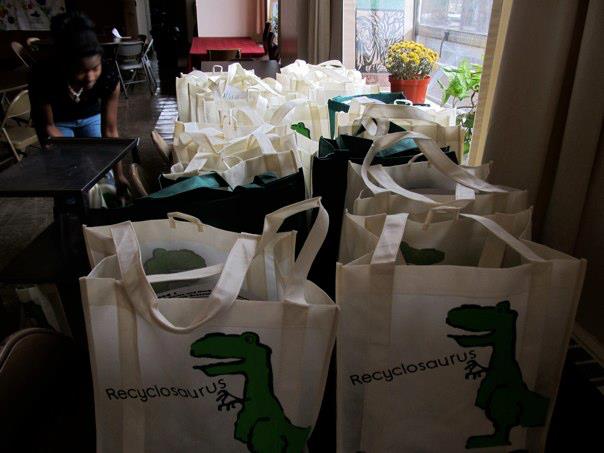
Special take home food bags with the recipe and ingredients for the Feed1 Teach1 meal were also available after the event.
"Everyone Coming together during such hard times and listening to one another making connections was definitely important," Salama Ra said. "Knowing there are people ready and willing to make a change to better our communities and promoting independence from governmental reliance is also important. Young people and older people coming together, having conversation, explaining to one another the type of support they need from each other to keep the strength to move forward is what's needed right now. We ended the event with the comment of 'Lets not stop here! Let's keep the conversation going. Let this not be the last time we meet. That sent the message to everyone that they are welcome back to the Commons and support EMEAC programs."

Building relationships; not gentrification is the way to enter community

Siwatu Salama-Ra (left) on Model D Gentrification panel
Since I arrived in Detroit just over a year ago, it's been hard not to notice that the question of gentrification has been one of the city's more hotly debated topics. About a month ago, my youthful colleague Siwatu Salama-Ra, EMEAC's youth team leader, ably shared her perspective as a born-and-raised Detroiter at an event sponsored by Model D on December 14 at the Virgil Carr Center.
Unfortunately, I wasn't able to attend that event in support EMEAC's point person with the Young Educators Alliance (YEA) but it was heartening to read via Twitter later how Siwatu held her own in the discussion with a decidedly pro-gentrification panel and audience. Then again, Siwatu is the daughter of one of Detroit's matrons of environmental justice, the Sierra Club's Rhonda Anderson, and as such she's been exposed to Detroit's trench battles all her life.
I'm sure Siwatu derived some of her poise and grace in addressing the issue from particular incident which happened over the summer when Siwatu and the YEA team tried to visit the North Cass Community Garden during EMEAC's Summer Camp activities. The YEA team has since gone on to win the Spirit of Detroit Award for their role in the city's Youth Environmental Green Summit and hold an innovative youth-led community discussion on Detroit's future called Feed1 Teach1 in December. They got a first hand experience with the ugly side of gentrification when they were denied a visit to the garden on the pretext that "there had been some recent thefts" for which the garden's guardian somehow surmised they were or would be responsible for.
When a meeting was arranged later by community members to discuss the incident, a spokesperson for the "community" garden said that while she was sorry for the incident, the North Cass Community Garden did indeed NOT see themselves as part of the community -- rather elites coming into the community -- and that despite the garden's name, no one should mistake that the North Cass Community Garden wasn't in fact a community garden.
So after reading a particularly well-written piece headlined "Lost in Detroit: A Gentrifier's Story," by Tommy Simon on HuffPost Detroit, I thought I'd weigh in on the subject as someone else who recently moved into the city.
While I enjoyed reading Simon's piece very much, and appreciated the way he seemed sensitized to the criticisms of the current move toward gentrification in the area formerly known as the Cass Corridor, there was a sense of entitlement implicit in statements like:
"I am not saying you should feel worse for me than the single working mother... who has to decide between buying medication for her ailing mother or food for her children. I am simply saying that I want to be an employee... I want a job. And not just for me, but for my droves of partially employed friends, who are also gentrifying Detroit."
Wasn't the whole purpose of bringing in a creative class that they would find ways to create economic opportunities for themselves? Maybe that's what the elites at the North Cass Garden call what they're doing, although there's no shortage of other successful urban farms which manage to pull it off without iron gates and or elite status. As for Mr. Simon and friends, I'm not sure whether they consider themselves elite or not, but there definitely seems to be the same sense of entitlement and privilege.
In essence, what we got from this enterprising young writer and humorist was a very unique and creative job application. For that you've got to give him props, but on second look his cluelessness about how to respectfully enter a community speaks to what's wrong with the same gentrifying mentality that doomed the initial roll outs of the Detroit Works Projects.
For starters, I'm sure Simon and his "droves of partially employed but well-educated friends" were well aware coming into Detroit that the "good old days called the 90s" were made obsolete when many of their suburban parents supported political candidates that supported the exportation of the city's manufacturing base and tax holidays for the businesses whose record profits derived primarily from those jobs going to slave wage-having, no-union having, no-environmental regulation-having countries around the globe. So announcing yourself as a Tommy-come-lately who deserves a job at a time when thousands of hard-working, well-educated Detroiters are losing theirs may not be a successful strategy.
Of course, Mr. Simon and his friends are only going on what they've been told by the true gentrifiers. These are the same real estate and banking interests that have played the political shell game for decades by preying on white fears of integrated communities and profiting handsomely off white flight, giving us the urban sprawl we have today. Now that they've run out of room going outward, the game goes back to buying up undervalued real estate in the city and luring the children of suburbia back into the city with a narrative that casts you all as prodigal sons and daughters returning as saviors who will clean up the city and make it livable again just by gracing us all with your presence.
The only problem is that the slick ad campaigns the true gentrifiers are taking out in newspapers in New York and other over gentrified, over priced cities where many citizens increasingly can no longer afford to live, are selling you rotten tomatoes. They appeal to your pioneering heritage with the idea that, like the whole continent once was, Detroit is in Tommy's words "a land of opportunity and open space." Sure we all do want to live in safe and clean communities, but it would be helpful if political leaders understood that the tax dollars paying their salaries would best invested first in the people and programs that have already (again in Tommy's words) "become a part of their neighborhood, support their local businesses, and work hard like everyone else." Investing first and foremost in the people who have a proven, genuine stake in the city would seem like a much better way to spend the city's money.
As for us commoners moving into the city, the way for us to become Detroiters is by identifying ourselves with the residents that are here, as opposed to the gentrification crowd. From my own experience as a New Age Arkansas traveler and global nomad, I've always found it much more satisfying personally and professionally to enter a community by focusing on building relationships. Frankly I can't identify with anything that presumes I'm owed anything just by virtue of my presence alone. As a college educated veteran of two branches of the U.S. military, I often found myself working for below average wages all too often. My payoff was in the service to that the particular community and the relationships that I built in the process.
Whether it was as a navy chaplain's assistant in Oakland, California, a literacy program coordinator and later a corporate trainer in Silicon Valley, a journalist in rural Arkansas, a sports writer in Memphis, a teacher in the Caribbean or an environmental justice advocate in Detroit, I've always seemed to manage to find a home and employment even in the worst of economic circumstances. But make no mistake about it, that's always been possible by building relationships and getting to know people who challenged me to move beyond my comfort zones.
So the one thing I would suggest to would-be gentrifiers like Tommy and friends is don't believe the hype. Detroit doesn't need elitist gentrifiers who are looking for opportunities to benefit only themselves, but citizens who will get in the trenches and help rebuild the city from the ground up. I gave up a rewarding job making twice what I do now in a unique and beautiful part of the world to come to Detroit. In the interest of full disclosure, it was because I happened to fall in love with "the prettiest girl on the west side." To which her reply was "Only the west side?" Still I truly believe that there's no better way than to enter community than building relationships.
Since being here, I'm amazed at the quality of people and opportunities I see every day. Those sustainable opportunities are being created at the human level, but of course, you have to have your feet planted firmly in the ground in order to see them. From on high, they are much more likely to miss them.

DFY set for monthlty gathering with 5E/Heru around cooperative economics


5E and the Heru will host the January DFY gathering
On January 28th, the art and media based organizations 5 Elements Gallery and Heru in partnership with Detroit Mural Factory will team up with Detroit Future Youth to host the latest monthly gathering of youth centered Detroit based organizers. The gathering will be the 8th in a year long series of gatherings that aim to help youth organizers become more familiar with the work of other youth organizers in Detroit. This month's gathering will focus on 5e Gallery, the HERU and Detroit Mural Factory's collaborative run youth leadership project called the BUSinESS Program, whose work focuses around cooperative economics. Cooperative economics as these organizations define it is an economic system whereby individual communities can be self-sustaining and autonomous.
"We have assessed that our community's greatest need is to be able to depend on it's community members and local natural resources for positive sustainable growth and development,” said Heru organizer, Bryce. “Our communities want to live abundantly through the practice of 'working together' to create mutually-exclusive revenue-generating endeavors, with zero dependence on or hinderance to economic growth based on the lack of fiat currency.”
In an effort to better demonstrate how cooperative economics can work within the community, the event will include among other highlights, a community marketplace. The marketplace will encourage community members to practice the skill of "going to market" as both consumers and sellers by bringing products with them to the gathering that they can then trade with others in a fair and equal way. But the marketplace is not simply about “economic trade.” It will also help to grow and develop a new understanding of individual and community identity. As Bryce says, "The community marketplace is necessary because through these, we grow in our practice of identifying as creators, skilled persons, entrepreneurs, and simply establishing community marketplaces serves as physical proof that we can and will create our own economic opportunities."
A highlight of the gathering will be a fashion show that will feature the outfits and various fashion skills of community members. The show is expected to be fun, but also to act as a real life situation that can best demonstrate how community members can use media for their own means. As Bryce says, "being that fashion for us is considered a form of mass-media (using textiles, apparel, and design brands to communicate specific social messages) this fashion show/concert was a great, natural, and highly engaging way for us to fuse our respective organizational capacities, create products cooperatively, and further the community conversation on what cooperative economics looks like and how easy, effective, and impactful it is to work collectively.”
The gathering is being co-organized by Detroit Future Youth (DFY), a program that aims to strengthen and deepen youth social justice organizing in Detroit by partnering with and supporting youth programs that focus on justice based education and multimedia creation.
As always, youth will take center stage in the gathering. Not only will they be participants, but they will also help to organize and run the fashion show and will even be doing music performances. As Bryce notes, centralizing youth is essential to helping to change Detroit for the better.
“Youth are the key players in the creation of a divine Detroit being that they literally are the population whose future will most directly be affected by our present adult decisions. It is the youth, with their unbridled imagination and perception of invincibility, that will fearlessly create new ideas to shape our Detroit's new path of love, community, and sustainability.”
The gathering will be held from 4-8 pm at 5e Gallery (2661 Michigan Ave). Prior to the youth gathering community members of all ages are invited to attend a community dialogue at the space from 12-3pm. Both the gathering and the community dialogue are open to the public, but people are encouraged to RSVP to youth@DetroitFuture.org to insure enough space and food is available.
Next month's gathering will be held on February 25th and will feature the work of Detroit Impact.