5E/Heru celebrate building reopening by hosting January DFY gathering

February 29, 2012

Tanesha Fashion performs "It's Me"
DETROIT – The 5 Elements Gallery and the Heru Organization were joined by the rest of the Detroit Future Youth (DFY) groups in celebrating the reopening of their non-profit visual art and hip-hop culture gallery on January 28 in Detroit's historic Corktown District. Approximately 70 community members from the 12 DFY member organizations and their supporters turned out for the event which featured workshops centered around 5E/Heru's seven power principles, performing arts, hip hop fashion exhibits and a special meal prepared by local family-owned caterer Sunflower Mama.
“We now have our building back to do our programming in a consistent space,” said 5E's Piper Carter. “We had been like nomads bringing our technology and learning into various environments, which was great as far as exposure for ourselves and our youth. Now we will have a space they can call their own, and they are very excited about helping take care of the building as well as continuing the workshops and field trips.”
DJ Sicari Ware turns over the wheels of steele to 5E Youth
The 5E Gallery was founded by Detroit Disc Jockey Sicari Ware in 2008 as a creative outlet for the city's art and music communities. Its mission is to increase public awareness and appreciation of Detroit's contemporary visual arts and music communities through exhibitions and educational programs. 5E and The Heru work collaboratively to support and mentor young up-and-coming local artists.
The groups believe that contemporary art and Hip Hop transcend international boundaries and involve all forms of visual expression, including painting, sculpture, drawings, prints, illustrated books, photography, architecture, design, film and video. They also embrace new art forms, which reflect and explore the artistic issues of today, but are yet to be developed or understood.
“It was awesome to see the 5 Elements Gallery space open again,” said DFY Coordinator Alia-Harvey Quinn. “5 Elements Gallery has been a partner on the deepest level, before the Detroit Future work even formally began. As a member of the Detroit Digital Justice Coalition, 5 Elements Gallery helped create the vision for this work. It has been an honor to support them and the work they do with young people.”
DFY Youth discuss principles during a breakout session
Following an opening reception catered by Akila Muhammad's Sunflower Mama's Vegan Catering featuring locally grown organic food, the gathering broke out into workshops to discuss each of the groups' seven power principles. Those principles are: cultivating self knowledge and awareness, recognizing self as the beginning of community, deliberately practicing positive and productive expressions, respecting organic learning and all intelligence, positively creating reality to empower others, nurturingly inspiring accountability, and growing substantial infrastructure to help the community flourish.
The gathering then reconvened to creatively share their reflections on the principles. The innovative ways of presenting those reflections ranged from call-and-response, to skits, to improvised rhyme saying. That was followed by a presentation on collaborative economics by Detroit Future's Jaun Martinez, who is also a member of the Beehive Collective. Cooperative economics is one of the core principles shared by DFY, 5E and The Heru. As part of the DFY Collective the groups have been partnering to develop cooperative economic models developed by area youth.
“It was informative, interactive, completely in line with our principles as well as the principles of the Detroit Future Collective,” said Carter. “It was fun for all.”
The fun didn't stop there as the event was highlighted by a non-stop fashion show accompanied by DJ Sicari's music with 5E/Heru artists King Kold, Taneesha Fashion, Bryce Anderson-Smalls and Kadiri “Sirius” Dobey taking the mic. King Kold performed “Let 'em Know.” Young Teneesha stole the show with her performance of “It's Me,” and Bryce and Kadiri brought down the house with a new version of their food justice anthem “Bootleg Food.”
5E member struts his stuff during fashion show
“As far as 5E/Heru we are structuring our programming more,” Carter said. “We will have slightly more formal skill learning with regard to media creation, software, principle building, media literacy, constructing messages, building issue based campaigns, refining media skills, critiquing our work, researching facts, etc. Our way is more organic and we will continue with this organic style of facilitating as well as include a consistent time for structured learning activities.”
The January gathering marked a milestone in the progress of the DFY Network. Coordinators said they are looking forward to deepening the work of the network for the remainder of the programs funding cycle.
“One of the overarching goals of Detroit Future Youth is to facilitate deepened relationships among the partners,” Harvey-Quinn said. “We do this largely through gatherings, which are hosted on a rotating basis by one of the partnering organizations and attended by all the other organizations. I think this gathering proved that relationships are deepening.
“It was great to see youth from different organizations, backgrounds, neighborhoods, and ethnicities dancing and having fun together. And for Detroit Future Youth, working to deepen relationships is not just about creating feel-good-moments; we work to deepen relationships to increase our capacity and sustainability. At the end of this 16 month funding period, because of the time spent together, these groups should be comfortable attending each others workshops, sharing curriculum, partnering, asking for support and offering support. Facilitating deepened relationships means that our work will continue even if funding is unavailable.”
For more information on the groups involved in this event visit: 5egallery.org, theheru.org, detroitmuralfactory.com or youth.detroitfuture.org or Sunflower Mama at http://www.facebook.com/pages/SunflowerMamas-Vegan-catering-and-Gluten-free-soups/375886795760794?ref=ts&sk=wall.

Whole Note Healing Collective a work in progress at CCC


Photo by Metal Mountain Arts
DETROIT -- The Whole Note Healing Collective is a cooperative community space organized by activists, healers, health practitioners and health and healing justice organizers. The collective includes leaders and advocates in Yoga, Reiki, Acudetox (Ear Acupuncture), Eco-psychology, Massage, Full Spectrum Reproductive Services, Belly Dance, Conflict Resolution and more. All members of this diverse group have multiple skills, offered as gifts to the community at large and are leaders in their own right.

Whole Note is a work in progress (and always will be). Currently, they are doing extensive research on health & healing initiatives around the country and gathering information on principles, guidelines, and operating procedures. All recommendations are welcome. In the meantime, Whole Note is working on designating space at the Cass Corridor Community Commons (C3) and offering select services.

Services available
Reiki

Reiki is a Japanese technique for stress reduction and relaxation that also promotes healing. It is administered by "laying on hands" and is based on the idea that a "life force energy" flows through us and is what causes us to be alive. If one's "life force energy" is low, then we are more likely to get sick or feel stress, and if it is high, we are more capable of being happy and healthy.

Reiki was rediscovered by a Japanese man, Dr. Mikai Usui. Its history is ancient and the concepts are present in several cultures.

While individual treatments will always be available, Whole Note will also be offering group Reiki healing in a shared, community space. Reiki Thursdays will be a collective healing space because we are inspired to heal together. Reiki Thursdays will be offered in one large room with individual treatment areas set-up for separate treatments. Stay tuned for more information.
Individual or group Reiki treatments can be scheduled by emailing: Reikithursdays@gmail.com.
Healing Belly Dance

Belly Dance classes are offered on Monday, Friday and Saturday. They are taught with a focus on empowering women (and others) to connect with their brightest self. Basic Belly Dance techniques are taught by using North African rhythms and encourage participants to accept their bodies just as they are. Belly Dance is for every woman's/person’s body.
For more information, contact Sanaa at thehealingbellydancer@yahoo.com 313.478.3920.

Update and Upcoming

The Good Vibrations Wellness Fair and Fundraiser has been postponed until April. Plans are underway for a city-wide fast and holistic health fair fundraiser. As details for this event and others become available, they will be posted in Whole Note’s calendar: http://wholenotehealing.wordpress.com/.


DFY Reimagines Leadership at Detroit Future in December

January 25, 2012

Examples of Emergence
DETROIT -- Organizations and community members from across Detroit came together on Saturday December 10th for a day of discussion and community building.  Featuring two events put on by Detroit Future Youth (DFY), the day focused on examining what kind of leadership is necessary to change and rebuild Detroit. DFY is facilitating a network creation process that aims to strengthen and deepen youth social justice organizing in Detroit by partnering with and supporting youth programs that focus on justice based education and multimedia creation.

The day began at The Cass Corridor Commons with the Reimagining Organizing, Movements, Leadership event. Centering the voices of community members, the event asked participants to imagine what cooperative, shared leadership, vision based (not just focusing on a specific “enemy” to stand against), small scale type of organizing might look like. Organizers took their inspiration from the scientific theory of “emergence,” where the patterns and systems that arise out of groups of individuals working together with no one directing and no one able to predict what pattern or system will emerge from the groups working together.  Birds flocking together or schools of fish swimming together are examples of emergence in nature.

Contrary to the standard opinion that without a central leader making decisions for everybody else, chaos would ensue, the theory of emergence points out that complex and significant work is accomplished repeatedly throughout the natural world without having a central leader. But it’s not that there is no leader--it’s that every player in the “emergence” acts as a leader. Or, as co-organizer Adrienne Maree Brown succinctly stated, “We need a leaderful movement instead of a leaderless movement.”

The second event of the day shifted over to the Allied Media Project’s office at the Furniture Factory. Focusing on youth leadership, participants shared a meal together, then broke into groups to work through various questions like, “What makes a great leader?” and “When have you been a leader?” Youth in the room were overflowing with answers, pointing out that, “Great leaders believe in the people they’re working with,” “They step in and help others work out their mistakes,” and “They are trustworthy and trusting of others.” Youth also noted that great leaders don’t always try to lead; that they also give up control and let others lead as well.

The day finished with music and poetry performances from community members. Invincible performed songs off her new project, “Complex Movements”. Youth string players from Capuchin Soup Kitchen’s Rosa Parks program helped her to perform her song “Apple Orchards”, and Rosa Parks youth dancers demonstrated their moves for the song “Detroit Summer”.

Other performers included: King Cold, Jade, DJ El Nina, Tanisha, DJ Sicari, and Bryce from 5E/Heru. Phresh Pharoah, Tederial Hall (youth co-host), Domonique Baul and Dontai Mitchell represented from Vanguard. Patrick Geans and Kadiri Sennifer represented from EMEAC, and Isaac Miller from Detroit Future Schools also performed.

The intergenerational performances helped to illustrate what entire communities can do when they move together.

Durban Climate Change Summit report back: 'We have to do it ourselves.'

January 24, 2012

EMEAC Associate Director Ahmina Maxey (far left)
DETROIT -- Following attending the 2011 United Nations Framework Convention on Climate Change (UNFCCC) in Durban South Africa, EMEAC Associate Director Ahmina Maxey expressed both disappointment with the official outcome, and encouragement with the networking done as a delegate for the Grassroots Global Justice (GGJ) alliance during her January 12 report back to the Detroit environmental Justice community at the Cass Corridor Commons.
"We basically felt like this was a farce and that nothing came out of it. We realized that if anything is going to get done, we have to do it ourselves," Maxey said. "There was a press conference at the end basically to call out the United States and Canada because they basically stalled negotiations."
The UNFCCC's 17th annual Conference of the Parties (COP) was designed to uphold the 1997 Kyoto Protocols aimed at reducing the world's carbon emissions and reduce climate change. The UN's stated purpose for having the annual COP is to assess progress toward implementing the Kyoto Protocols, an international environmental treaty signed by 191 nations and requiring countries to reduce their greenhouse gas emissions by 5.2 percent between 2008-2012.  Of the signatories to the treaty, the United States is the only one not to ratify the treaty, and Canada has stated its intention to withdraw all together.
According to the British newspaper The Guardian, "The Durban conference ended on (December 9, 2011) with a last-ditch deal whereby developed and developing countries will for the first time work on an agreement that should be legally binding on all parties, to be written by 2015 and to come into force after 2020." http://www.guardian.co.uk/environment/2011/dec/12/durban-climate-change-conference-2011-southafrica
The Protocol was initially adopted on December 11, 1997 in Kyoto, Japan, and entered into force in February of 2005.
"If you read the news the entire time we were there, it said India and China stalled the negotiations, and kept things from going forward, but the U.S. was behind the scenes making sure that no decision came out of it," Maxey said. "Most countries wanted the Kyoto Protocol to continue however the U.S. and Canada did not. Canada pulled out of negotiations and the U.S. threatened to."
Maxey, who also attended last year's COP 16 in Cancun, Mexico as part of the GGJ delegation with EMEAC Executive Director Diana Copeland, was also concerned to see the U.N. leave in place controversial "carbon trading" agreements such as Reducing Emissions from Deforestation Degradation (REDD) and Clean Development Mechanism (CDM).
"Their solution is basically to monetize and commodify trade pollution around the world. That is the majority of what happens inside COP," she said. "Within COP there is a lot of negotiating and lobbying. It is similar to local politics except on a much larger scale.
"REDD essentially is where polluting countries or developed countries like the U.S., Canada, and those of the EU can purchase credits in developing countries like Ecuador or the Philippines. We purchase carbon credits from them, and continue to pollute here in the U.S., in communities like Southwest Detroit.  REDD is also affecting forest communities in poor developing countries. Indigenous peoples who have lived on their lands for hundreds of years are being removed or tricked into selling their land."
Similar to her experience at COP 16, it was outside the conference halls among other grassroots organizations and activists from around the world that Maxey found solidarity in what South Africans call "civil society spaces." During their stay, GGJ stayed at the University of KwaZulu-Natal, which lies among hills in South Durban. While there the GGJ delegation (consisting of 14 people from California, New York, Oregon and areas across the U.S.) met with members of the South Durban Environmental Alliance who took conference attendees on a "toxic tour" of the area.
"Oil refineries are polluting a lot in Detroit along with other industries. It's basically the same in South Durban. That's where their polluters are," Maxey said. "They have paper mills. They have refineries. They are located close to schools and their environmental regulation is a lot more lax than ours. You can see how close the homes are to the refinery.  Maxey opened her presentation by showing slides comparing the oil refineries in South Durban to the ones here in Southwest Detroit. She also met with people from India, Central America and Africa who were fighting their own environmental justice struggles similar to Detroiters around food sovereignty and waste incineration.
"New Africa launched a food sovereignty alliance. I think food sovereignty seems to be the issue that is really hitting everyone everywhere. I think we can learn a lot from other people in that regard," she said.
The learning also extends to India where "waste pickers" are fighting to keep out incinerators in favor of people-powered efforts at zero waste.
"I also wanted to be in consolidation with the other Zero Waste groups," Maxey said. "The waste pickers and Zero Waste movements are in alignment because we are both being threatened by incinerators. Companies are coming into these developing countries to put in waste-to-energy incinerators, and these wastepickers are saying 'we don't need you, we can handle our country's waste just fine without you' ".  International wastepicker groups tout the idea of zero waste, and work to recycle and compost as much trash as they can.  There is a lot the U.S. can learn from these developing countries.
Other issues addressed at the grassroots level were uplifting real solutions to environmental injustice and the threat of climate change by groups like La Via Campasina and the Indigenous Environmental Network. Together with other grassroots organizations from around the world, they began the conference with a 10,000 person march through Durban and a press conference afterwards.
"We are a national alliance of grassroots organizations. We are working to building a popular movement for peace, and democracy in a sustainable world," Maxey said. "Our overall goal was to ask the U.S. State Department to set real emission reduction targets, and follow the Cochabamba Peoples Agreement. The Agreement sets a target of reducing carbon emissions by 50 percent. We also wanted the U.S. to stop pushing false solutions such as carbon trading.

Greener Schools Family Dinner Nights engaging students and parents around healthy eating

DETROIT -- Building off a successful start to close 2011, more EMEAC Greener Schools Family Dinner Night events are in the works at Nsoroma Institute and Palmer Park Preparatory Acadmey (P3A) in early 2012 according to program coordinators Sanaa Green and Priscilla Dziubek. Both schools have hosted a pair of the special workshops aimed at educating the community on the dangers of childhood obesity and the pending 2012 U.S. Farm Bill.
"Family Dinner Nights have gone pretty well," said Green. "We've done two at Palmer Park Preparatory Academy and then two an Nsoroma. Each one has been considerably different. We hope to communicate some of the primary considerations of the Farm Bill. We want to show the parents how the Farm Bill affects them directly. It affects school lunch. It affects the foods we are able to buy."
The Greener Schools team hosted the first P3A Family Dinner Night October 27. It included a review of and discussion of the teen produced video, "Green Pepper and the Liquor Store." On November 9, the Greener Schools team hosted the initial Family Dinner Night at Nsroma. Before the end of the year, there was another December 14 and 15. Up to 20 people attended and the student prepared dinners.
"More students attended than we expected. We thought it would be just adults. Some students were great contributors to the conversation about the Farm Bill," Green said. "
"At P3A we talked about the Farm Bill and the school lunches and the eighth graders were very interested and concerned about the having the healthy choices that they want for lunch. They were very energized about it and Family Dinner Night was a way to get what we were teaching the students in class and share that with the parents. The ultimate goal is to reduce childhood obesity, so there has to be family involvement,"
The Family Dinner Nights at Nsoroma Institute, an African-centerd charter school in east Detroit, has been particularly well received organizers said.
"I think the main difference between P3A and Nsoroma is that at Nsoroma a part of their curriculum is talking about food," Dziubek said. "They do food sovereignty work. At P3A we have the garden and the children come to the lab and work on all our environmental projects, so we are trying to target some of the younger kids.
"We have the preschool program (at P3A) where parents come every day but the parents are very busy. We've had a couple of people that have come to both of them, but that's just what we have to start building the relationships that we have to get more parents involved. We are working in the schools, and we look at the Family Dinner Nights as an opportunity to draw in more of the community and get more information out through the community."
Nia-Joy added that Nsoroma's emphasis on culture has made the Family Dinner Night's there particularly enjoyable.
"Especially at Nsoroma, the parents are really interested," she said. "They came and stayed the whole session. We also had a lot of children come and they participated in the discussions about the Farm Bill and contributed quite a bit to the discussion.
"The culture Nsoroma is different too. It's a charter school so the parents like to be engaged in the philosophy of the school. Since they are already interested in healthy eating and healthy living, they already like the notion of food justice. When they come in everyday, they are involved in the culture of the school. Even though we haven't had an overwhelming number of parents come, we've been pleased with the turn out.
The next round of Family Dinner Nights are being planned for February and March. The exact dates are yet to be finalized but the community event at Nsroma will be catered by Peoples Community Kitchen, which is one of EMEAC's partners in the Cass Corridor Commons. The Environmental lab at P3A is actually the former home economics room and has plenty of preparation space. Eighth grade students at both schools will help prepare the meal as part of the youth leadership development initiative.
"What we are going to do next is move to having Angela Newsom from Peoples Community Kitchen to actually prepare the main course," Green said. "She's going to come and prepare the meal and give recipes on healthy eating that their parents can use for themselves.
"The eight graders are actually being trained now to work with the pre-schoolers and the kindergarteners. We are working to get the message out about the importance of good health and fighting against childhood obesity to not only the students but also the parents. If we can sandwich that information between the youth and their parents,

YEA Team hosts Feed1 Teach1 at Cass Community Commons

YEA Team kicks off Feed1 Teach 1 2011
DETROIT -- Approximately 70 people from the Detroit Metro area came out last month to the Cass Corridor Commons for the Young Educators Alliance (YEA) Feed1 Teach1 special community conversation and dinner focusing on the recent public assistance cutbacks enacted by Governor Rick Snyder.
"The Feed1 Teach1 event couldn't of been better, it turned out exactly how we planned it," said YEA Team Leader Siwatu-Salama Ra. "We are a youth leadership team that understands the importance of equality and justice for our community, and the knowledge that when a bias time reaches us as a people, we have the resources to pull together and educate ourselves. When Governor Snyder Announced the Cash Assistance Cut backs, the Young Educators Alliance felt that the time was now to hold a community event to first have a conversation and second to determine what action should be taken."
The event began with a special meal prepared by the YEA team with the support of People's Community Kitchen Detroit. The YEA team then did a series of presentations around the social justice effects of the cutbacks, and later held a panel discussion with YEA Team members who range in age from 21 to 15.
YEA team members are Salama Ra, Roger Boyd, Paris Smith, Raven Roberts, Anthony Grimmett, DeRaina Stinson, Sabrin Salaam, Donovin Murray, Elayne Elliot, Noelle Frye and Malik Harris. The team worked with Peoples Kitchen Detroit to prepare the special meal served during the event.
"(YEA) facilitated a great dialogue about the effects of recent welfare cuts, and what we can do to feed ourselves without having to rely on the government," said EMEAC Associate Director Ahmina Maxey who also works with YEA through EMEAC's Stand Up Speak Out (SUSO) program. "I think the event was really well received by the community.
"For some of them this was their first time facilitating large groups, and the facilitation training they received from Diana and William Copeland beforehand was a real help.  I was especially proud of some of the YEA team members like Malik Harris, who are usually really quiet, that took the opportunity to speak up about welfare cuts."
Following the panel discussion, YEA Team conducted two popular education exercises. Team members later broke into pairs to lead separate small group discussions on several topics of concern for those in attendance. Attendees at the event ranged a wide selection of community members including attorneys, educators, activist, parents, civil servants and homeless families. 
Anthony Grimmett and Paris Smith at breakout session
"A part worth mentioning that went on behind scenes is that, before the Feed1 Teach1 event started, there was a moment when the whole team stepped outside with flyers in hand," Salama Ra said. "They were encouraging people off the streets to come and be heard in addressing the welfare cut backs while enjoying a delicious meal supporting healthy home cookings for Detroit families. During the last minute outreach we pulled in more community members, activists and one lawyer who was delighted to stay in touch and provide services.
"I definitely want to brag on The YEA team for doing such a hard task so beautifully. There were three months of planning and getting organized. Every YEA session for two months was filled with strong dialogues around the new governmental plan which helped the YEA team comfortably speak about the subject. During the Feed1 Teach, the YEA team did a substantial amount of facilitation, and it opened a safe space where everyone's voice was heard."
Siwatu leads closing discussion
The evening ended with everyone coming back together to hear report outs from the smaller group discussions. Afterwards, community members shared some closing thoughts and SUSO Youth Program Coordinator William Copeland shared a poem.
Special take home food bags with the recipe and ingredients for the Feed1 Teach1 meal were also available after the event.
"Everyone Coming together during such hard times and listening to one another making connections was definitely important," Salama Ra said. "Knowing there are people ready and willing to make a change to better our communities and promoting independence from governmental reliance is also important. Young people and older people coming together, having conversation, explaining to one another the type of support they need from each other to keep the strength to move forward is what's needed right now. We ended the event with the comment of 'Lets not stop here! Let's keep the conversation going. Let this not be the last time we meet. That sent the message to everyone that they are welcome back to the Commons and support EMEAC programs."

Building relationships; not gentrification is the way to enter community

Siwatu Salama-Ra (left) on Model D Gentrification panel
Since I arrived in Detroit just over a year ago, it's been hard not to notice that the question of gentrification has been one of the city's more hotly debated topics. About a month ago, my youthful colleague Siwatu Salama-Ra, EMEAC's youth team leader, ably shared her perspective as a born-and-raised Detroiter at an event sponsored by Model D on December 14 at the Virgil Carr Center.
Unfortunately, I wasn't able to attend that event in support EMEAC's point person with the Young Educators Alliance (YEA) but it was heartening to read via Twitter later how Siwatu held her own in the discussion with a decidedly pro-gentrification panel and audience. Then again, Siwatu is the daughter of one of Detroit's matrons of environmental justice, the Sierra Club's Rhonda Anderson, and as such she's been exposed to Detroit's trench battles all her life.
I'm sure Siwatu derived some of her poise and grace in addressing the issue from particular incident which happened over the summer when Siwatu and the YEA team tried to visit the North Cass Community Garden during EMEAC's Summer Camp activities. The YEA team has since gone on to win the Spirit of Detroit Award for their role in the city's Youth Environmental Green Summit and hold an innovative youth-led community discussion on Detroit's future called Feed1 Teach1 in December. They got a first hand experience with the ugly side of gentrification when they were denied a visit to the garden on the pretext that "there had been some recent thefts" for which the garden's guardian somehow surmised they were or would be responsible for.
When a meeting was arranged later by community members to discuss the incident, a spokesperson for the "community" garden said that while she was sorry for the incident, the North Cass Community Garden did indeed NOT see themselves as part of the community -- rather elites coming into the community -- and that despite the garden's name, no one should mistake that the North Cass Community Garden wasn't in fact a community garden.
So after reading a particularly well-written piece headlined "Lost in Detroit: A Gentrifier's Story," by Tommy Simon on HuffPost Detroit, I thought I'd weigh in on the subject as someone else who recently moved into the city.
While I enjoyed reading Simon's piece very much, and appreciated the way he seemed sensitized to the criticisms of the current move toward gentrification in the area formerly known as the Cass Corridor, there was a sense of entitlement implicit in statements like:
"I am not saying you should feel worse for me than the single working mother... who has to decide between buying medication for her ailing mother or food for her children. I am simply saying that I want to be an employee... I want a job. And not just for me, but for my droves of partially employed friends, who are also gentrifying Detroit."
Wasn't the whole purpose of bringing in a creative class that they would find ways to create economic opportunities for themselves? Maybe that's what the elites at the North Cass Garden call what they're doing, although there's no shortage of other successful urban farms which manage to pull it off without iron gates and or elite status. As for Mr. Simon and friends, I'm not sure whether they consider themselves elite or not, but there definitely seems to be the same sense of entitlement and privilege.
In essence, what we got from this enterprising young writer and humorist was a very unique and creative job application. For that you've got to give him props, but on second look his cluelessness about how to respectfully enter a community speaks to what's wrong with the same gentrifying mentality that doomed the initial roll outs of the Detroit Works Projects.
For starters, I'm sure Simon and his "droves of partially employed but well-educated friends" were well aware coming into Detroit that the "good old days called the 90s" were made obsolete when many of their suburban parents supported political candidates that supported the exportation of the city's manufacturing base and tax holidays for the businesses whose record profits derived primarily from those jobs going to slave wage-having, no-union having, no-environmental regulation-having countries around the globe. So announcing yourself as a Tommy-come-lately who deserves a job at a time when thousands of hard-working, well-educated Detroiters are losing theirs may not be a successful strategy.
Of course, Mr. Simon and his friends are only going on what they've been told by the true gentrifiers. These are the same real estate and banking interests that have played the political shell game for decades by preying on white fears of integrated communities and profiting handsomely off white flight, giving us the urban sprawl we have today. Now that they've run out of room going outward, the game goes back to buying up undervalued real estate in the city and luring the children of suburbia back into the city with a narrative that casts you all as prodigal sons and daughters returning as saviors who will clean up the city and make it livable again just by gracing us all with your presence.
The only problem is that the slick ad campaigns the true gentrifiers are taking out in newspapers in New York and other over gentrified, over priced cities where many citizens increasingly can no longer afford to live, are selling you rotten tomatoes. They appeal to your pioneering heritage with the idea that, like the whole continent once was, Detroit is in Tommy's words "a land of opportunity and open space." Sure we all do want to live in safe and clean communities, but it would be helpful if political leaders understood that the tax dollars paying their salaries would best invested first in the people and programs that have already (again in Tommy's words) "become a part of their neighborhood, support their local businesses, and work hard like everyone else." Investing first and foremost in the people who have a proven, genuine stake in the city would seem like a much better way to spend the city's money.
As for us commoners moving into the city, the way for us to become Detroiters is by identifying ourselves with the residents that are here, as opposed to the gentrification crowd. From my own experience as a New Age Arkansas traveler and global nomad, I've always found it much more satisfying personally and professionally to enter a community by focusing on building relationships. Frankly I can't identify with anything that presumes I'm owed anything just by virtue of my presence alone. As a college educated veteran of two branches of the U.S. military, I often found myself working for below average wages all too often. My payoff was in the service to that the particular community and the relationships that I built in the process.
Whether it was as a navy chaplain's assistant in Oakland, California, a literacy program coordinator and later a corporate trainer in Silicon Valley, a journalist in rural Arkansas, a sports writer in Memphis, a teacher in the Caribbean or an environmental justice advocate in Detroit, I've always seemed to manage to find a home and employment even in the worst of economic circumstances. But make no mistake about it, that's always been possible by building relationships and getting to know people who challenged me to move beyond my comfort zones.
So the one thing I would suggest to would-be gentrifiers like Tommy and friends is don't believe the hype. Detroit doesn't need elitist gentrifiers who are looking for opportunities to benefit only themselves, but citizens who will get in the trenches and help rebuild the city from the ground up. I gave up a rewarding job making twice what I do now in a unique and beautiful part of the world to come to Detroit. In the interest of full disclosure, it was because I happened to fall in love with "the prettiest girl on the west side." To which her reply was "Only the west side?" Still I truly believe that there's no better way than to enter community than building relationships.
Since being here, I'm amazed at the quality of people and opportunities I see every day. Those sustainable opportunities are being created at the human level, but of course, you have to have your feet planted firmly in the ground in order to see them. From on high, they are much more likely to miss them.

DFY set for monthlty gathering with 5E/Heru around cooperative economics


5E and the Heru will host the January DFY gathering
On January 28th, the art and media based organizations 5 Elements Gallery and Heru in partnership with Detroit Mural Factory will team up with Detroit Future Youth to host the latest monthly gathering of youth centered Detroit based organizers. The gathering will be the 8th in a year long series of gatherings that aim to help youth organizers become more familiar with the work of other youth organizers in Detroit. This month's gathering will focus on 5e Gallery, the HERU and Detroit Mural Factory's collaborative run youth leadership project called the BUSinESS Program, whose work focuses around cooperative economics. Cooperative economics as these organizations define it is an economic system whereby individual communities can be self-sustaining and autonomous.
"We have assessed that our community's greatest need is to be able to depend on it's community members and local natural resources for positive sustainable growth and development,” said Heru organizer, Bryce. “Our communities want to live abundantly through the practice of 'working together' to create mutually-exclusive revenue-generating endeavors, with zero dependence on or hinderance to economic growth based on the lack of fiat currency.”
In an effort to better demonstrate how cooperative economics can work within the community, the event will include among other highlights, a community marketplace. The marketplace will encourage community members to practice the skill of "going to market" as both consumers and sellers by bringing products with them to the gathering that they can then trade with others in a fair and equal way. But the marketplace is not simply about “economic trade.” It will also help to grow and develop a new understanding of individual and community identity. As Bryce says, "The community marketplace is necessary because through these, we grow in our practice of identifying as creators, skilled persons, entrepreneurs, and simply establishing community marketplaces serves as physical proof that we can and will create our own economic opportunities."
A highlight of the gathering will be a fashion show that will feature the outfits and various fashion skills of community members. The show is expected to be fun, but also to act as a real life situation that can best demonstrate how community members can use media for their own means. As Bryce says, "being that fashion for us is considered a form of mass-media (using textiles, apparel, and design brands to communicate specific social messages) this fashion show/concert was a great, natural, and highly engaging way for us to fuse our respective organizational capacities, create products cooperatively, and further the community conversation on what cooperative economics looks like and how easy, effective, and impactful it is to work collectively.”
The gathering is being co-organized by Detroit Future Youth (DFY), a program that aims to strengthen and deepen youth social justice organizing in Detroit by partnering with and supporting youth programs that focus on justice based education and multimedia creation.
As always, youth will take center stage in the gathering. Not only will they be participants, but they will also help to organize and run the fashion show and will even be doing music performances. As Bryce notes, centralizing youth is essential to helping to change Detroit for the better.
“Youth are the key players in the creation of a divine Detroit being that they literally are the population whose future will most directly be affected by our present adult decisions. It is the youth, with their unbridled imagination and perception of invincibility, that will fearlessly create new ideas to shape our Detroit's new path of love, community, and sustainability.”
The gathering will be held from 4-8 pm at 5e Gallery (2661 Michigan Ave). Prior to the youth gathering community members of all ages are invited to attend a community dialogue at the space from 12-3pm. Both the gathering and the community dialogue are open to the public, but people are encouraged to RSVP to youth@DetroitFuture.org to insure enough space and food is available.
Next month's gathering will be held on February 25th and will feature the work of Detroit Impact.

5E, Nsoroma take home top honors at 2011 Green Screen Youth Film Festival

December 1, 2011

Representatives of Nsoroma Institute, Five Elements
Gallery and the Ruth Ellis Center receive their awards
following Green Screen V

DETROIT -- Approximately 200 community members turned out to attend EMEAC’s Fifth Annual Green Screen Youth Environmental Film Festival on November 17 inside the General Motors Theater of the Charles H. Wright Museum of African American History. “The Launch of the Detroit Youth Food Justice Taskforce” presented by The Five Elements Gallery took home top honors while “The Defenders,” presented by the Ashante Moja Class of Nsoroma Institute, about community members waging a legal campaign against the Detroit Incinerator took home second place honors. 

“We had a record number of supporters for this year's Green Screen and for that we are extremely grateful,” said EMEAC Associate Director Lottie Spady. “This was a very exciting Green Screen as we were celebrating its 5th anniversary which is a milestone of sorts! The decision to hold it at the Charles H Wright Museum of African American History reflected our commitment to supporting Detroit and was exciting for the young people to have their work showcased in such an elegant setting. From the responses I got, Green Screen V was a hit for youth and adults alike.”

EMEAC's Lottie Spady, left, and Piper Carter address
the Green Screen audience
Also winning awards during Green Screen V were the Ruth Ellis Center for “Not Alone and Our Shoes” in the Best Environmental Justice Documentary Media category about anti-bullying efforts on behalf of Lesbian Bi-sexual Gay Trans-gender and Queer youth. EMEAC’s Young Educators Alliance won the Innovative Media EJ Media Award for “The Liquor Store and the Green Pepper” about access to quality food outlets in Detroit. The Most Creative Food Justice Music Video went to The Heru Organization and Five Elements Gallery featuring the Gardening Activism Media and Education Summer Camp for “Bootleg Food.” The Inter-Generational Media Award went to the Palmer Park Academy Environmental Lab for their oral histories project featuring the Gardening Angels of Hannan House. 

Detroit Summer’s LAMP Project won the Innovative Environmental Solutions Category for “Another Detroit is Happening.” The Innovative Food Justice Media category was won by The Lathrup Village Children's Garden 4H and Video Club  for “Green Fridays” on the subject of healthy eating choices. Project Achieve’s “Green Screen Project” on relandscaping Southwest Detroit won for Best Innovative Environmental Justice Media. The Innovative Environmental Media Solutions and Best Youth Artistic Approach to EJ Media went to Nosroma Institute for “The Pollution Haters,” “The Pollution King,” “From the Present to the Past,” and “Stop Polluting My Earth!” The Nsoroma MC’s also won the Best Environmental Justice Video for “Pollution! Solution! Revolution!” which was also themed around the Detroit Incinerator. 
The Defenders

“I know the group Zero Waste Detroit was very excited to see so much youth media around the incinerator and it was very encouraging to see the work being undertaken by Project Achieve to build awareness around environmental justice issues in River Rouge,” Spady said. The Lathrup Village Children's Garden 4H and Video Club never disappoints, and their entry, Green Fridays, which ‘turned over a new leaf’ for school lunches was well received. 

“It was very exciting to see how our young people express themselves through music and song and the music video category was rocking with all hands in the air to Bootleg Food and Pollution! Solution! Revolution! But what I feel is one of the key evolutions of Green Screen is the definition of ‘environment’ and recognizing that it is all of the elements that comprise where you live, work, play, and learn and your ability to be safe, happy, and healthy there. The entries from Ruth Ellis Center reflecting the challenges LGBTQ youth face around bullying really shared a timely and sensitive look at safety as environment.”

Sponsors for the 2011 Green Screen V event were Alldrink, Allied Media Projects, Avalon Bakery, Barnes & Noble College WSU Campus, Boggs Center, Building A Movement, Detroit Black Community Food Security Network, Detroit Food Policy Council, Detroit Future Youth Network, Earthworks Urban Farms and Capuchin Soup Kitchen, Great Lakes Bioneers, Gregg Newsome, Detroit City Council Member Kenneth Cockrel Jr and the Detroit City Council Green Task Force, Hugh McDiarmid, IHM Sisters of Monroe Michigan, John King Used and Rare Books, Kathryn Lynch Underwood, Laura Lein, Lou Novak, Marwil Bookstore, Inc, Michigan League of Conservation Voters, Mike Spencer, Motor City Brewery, People's Community Kitchen Detroit, Project South, Robinson Oil Company, Inc, Starbucks, Sugar Law Center, WSU Blimpie, WSU La Pita Mediterranean and Zero Waste Detroit. Together these individuals, organizations and businesses donated over $2,400 to support EMEAC’s environmental justice work in Southeastern Michigan. 

The Nsoroma MC's Michael, Antonio and Sean
in Pollution Solution Revolution!
Having established Green Screen as a Detroit-based event, EMEAC plans to host next year’s youth film festival inside the David Blair Grassroots Community Theater at EMEAC’s new home inside the Cass Corridor Community Commons, formerly the First Unitarian Universalist Church, at the corner of Forest and Cass Avenue. The facility is currently being refurbished under the direction of long-time Detroit cultural arts organizer Oya Amakisi, who has organized the annual Detroit Women of Color Film Festival and run the Detroit Grassroots Community Arts Theater. 

“By Green Screen VI, we will be housed in the David Blair Grassroots Community Theater in the Cass Corridor Commons. Green Screen will have landed so to speak,”  Spady said. “I see that leading to more community screenings throughout the year as well. Our media production workshops keep growing in reach so, I look forward to having at least one entry for each of our collaborative partner workshops next year!”

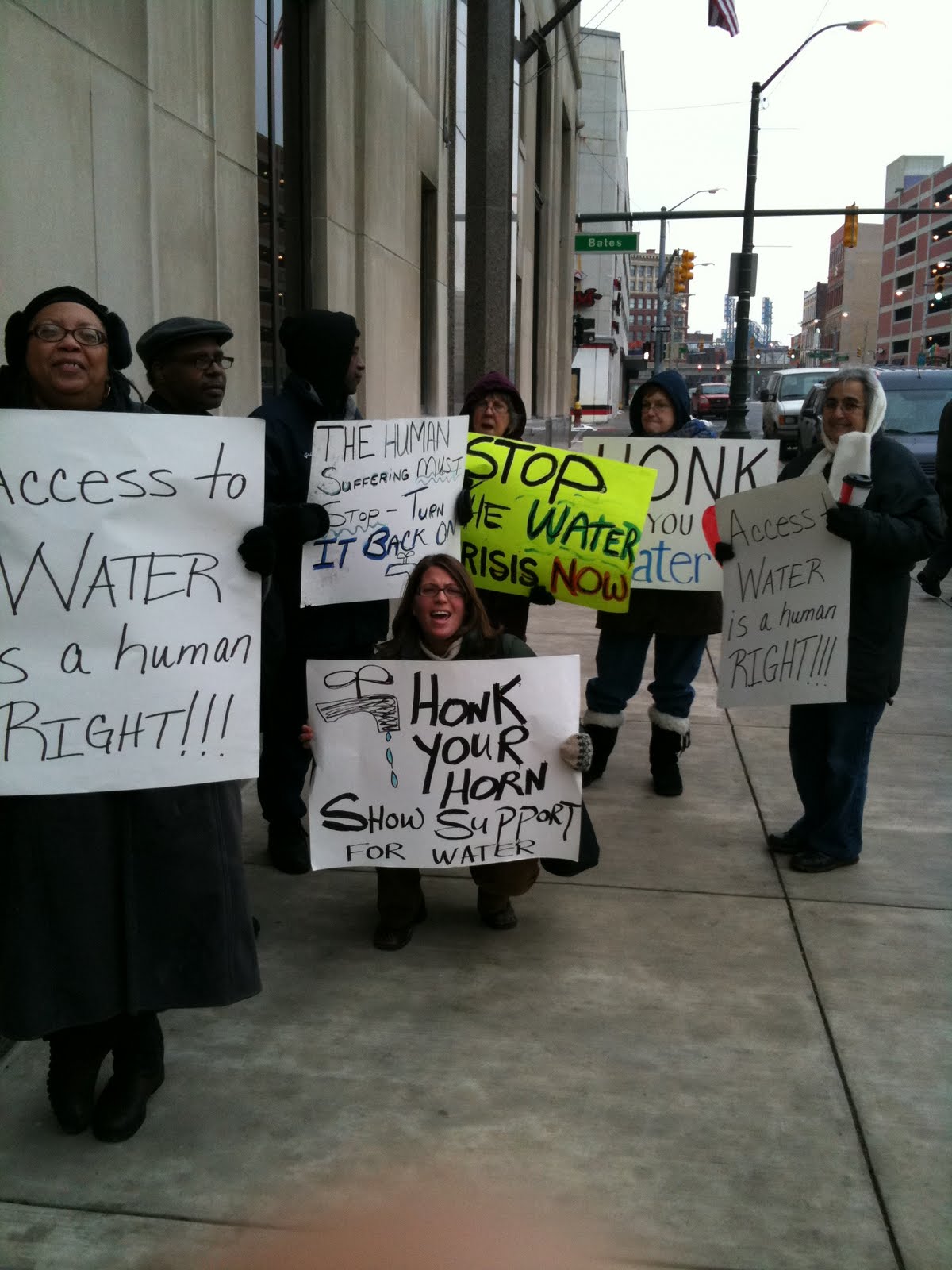
Peoples Water Board concerned about possibility that Cox decision opens door to water privatization

DETROIT -- Despite a long history of legal decisions to the contrary, specific language handed down in the November 4 federal consent decree by Federal Circuit Judge Sean Cox could lead to the eventual privatization of all the assets of the Detroit Water and Sewage Department (DWSD) according to members of the Detroit Peoples Water Board Coalition. 

On page eight of Cox’s ruling, the following sentence that is found on the root cause committee letter adopted by Judge Cox. 

“As a by-product of this decision, it is also clear that DWSD cannot be expected to fully comply with the Charter provisions related to Privatization (Charter Section 6-307)."

“That is very scary. That is unconstitutional. That destroys the Home Rule Charter Provision. It also effectively renders the voice of the people null and void,” said Peoples Water Board Commissioner at large Charity Hicks. “He’s effectively taken the door off the hinges to privatization the Detroit Water and Sewage Department’s Municipal Agency.”

The DWSD Home Rule Charter has very clear and direct language that says that the assets of the municipal authority of the peoples of the city of Detroit shall not be sold or transferred without the people’s consent directly. The charter also states that the DWSD, which provides water at discounted rates to much of the greater Detroit metropolitan area,  must operate on a non-profit basis. Since the early part of the last century, special interests outside of the city have unsuccessfully sought to wrest control of the water system from the city. 

Cox’s decision appears to be a clear departure from existing case law. 

“What he’s effectively doing is creating a pathway to strike off and sale pieces of the system or the whole system in tact to private industry,” Hicks said. “What he’s doing is vacating the charter and that provision of the charter that says you can’t transfer or dispose of the people’s assets without the people’s permission.”

Cox’s decision was based off recommendations made by a root cause committee set up to look into the city’s compliance with a federal consent decree handed down in 1977 over the city’s violations of the Clean Water Act. PWB members say that instead of addressing pollution concerns, the judge along with city council members Charles Pugh and Gary Brown, who comprised the root cause committee, rendered a letter undermining the charter and attacking public unions.

Members of the Detroit Peoples Water Board
protest earlier this year
“This is nothing but a back room deal between Mayor (Dave) Bing and two City Councilpersons [Charles Pugh and Gary Brown], approved in secret by a Federal Judge,” AFSCME Local 207’s attorney, George Washington told the Michigan Citizen. “It has nothing to do with ending pollution and everything to do with busting unions under the authority of a Federal Court order.”

Hicks agreed. 

“The City of Detroit’s Water and Sewage Department  has been under a federal consent decree since 1977. That’s over 30 years of federal over sight. On Friday the fourth of November, the federal judge who is over seeing the case gave an opinion based upon a committee that he selected,” Hicks said. “Who’s on it is Chris Brown representing the mayor. The president of the Detroit City council, Charles Pugh. The president pro tem Gary Brown and James Fausone, representing Wayne County on the Board of Water Commissioners. Those four people met over a 60 to 90 day period and crafted together this memo supposedly underlying the root causes of the federal consent decree.

“The Detroit Waste Water Treatment Plant was violating the Clean Water Act. That’s how we entered into the federal consent decree that’s lasted over 30 years. But what happens is rather than talking about the abatement of pollution, they went straight for the jugular of the waste water treatment plant and the water system itself by talking governance, control and authority.”

In addition, the ruling literally destroyed all the collective bargaining agreements of all the employees of the water board by saying they will have to separately negotiate with the administrator according to Local 207 Secretary Treasurer Michael Mulholland. 

“They didn’t mention pollution at all,” Hicks said. “They didn’t mention any strategies to come into
 compliance with the Clean Water Act. They didn’t mention green or gray infrastructure. They didn’t mention any plan afoot to help strengthen the water department’s ability to buffer run off and comply with the Clean Water Act. It was all about blame the charter. Blame collective bargaining, as if that was the cause of the pollution.

“Those things have nothing to do with the pollution. We are polluting because we are not doing the system’s work to stop the pollution. But rather than deal with how we operate and look at why we are polluting, they just are out to destroy the city’s governance.

Hicks said the Peoples Water Board is seeking community support from all of Southeast Michigan to oppose any privatization of the city’s water system. 

“We would like the community to help us keep the municipal enterprise agency that serves 120 communities,” she said. “Two to three million people receive their tap water from this source which is held in the commons and free from privatization.

“We want the water system that impacts our lives. We brush our teeth. We wash clothes. We all inhabit this region and the water should be held in the public trust. It should be free from privatization. That’s just point blank. Private concerns are private concerns, but because the water is a public concern, it should be publicly held. Nobody has the right to privatize such an important resource as water. Nobody.”
  
“What’s really interesting is we are are gearing up for a battle to maintain DWSD as the municipal enterprise agency that is run for the benefit of the public and not for the benefit of private interests. The Peoples Water Board is still working on access and affordability. We are still working on pollution and conservation, but right here the battle is about water being held in the public trust. There is this belief being propagated by private interest that the public is inefficient. There’s this belief that the public is corrupt. There’s this belief that the public is inept. All of that is false. Just because because a municipal authority that is not for profit controls an asset does not make it inefficient, corrupt or inept. Some things should be held in the public trust.”

Youth Food Justice Taskforce launches at North End Garden

Ms. Sheila Johnson, Anthony Grimmett, Roger Boy
and EugeneMoore talk with community members
at the launch of the Youth Food Justice Taskforce
DETROIT -- The Detroit Youth Food Justice Taskforce officially launched on November 6 with a special work day event at the Moore Community Garden in Detroit’s North End neighborhood. Youth Food Justice Taskforce members were joined by the garden’s founder, Eugene Moore, other community members  and youth from the Five Elements Gallery in hopes of revitalizing a neglected community resource. 

“Of course we are just getting started,” said North End resident and co-founder of the Youth Food Justice Taskforce Anthony Grimmett.  “This is a time for learning before we actually go out and start making moves in terms of food justice. I’m really excited to get out and to do as much as I possibly can.”

Grimmett, EMEAC Volunteer of the Quarter Roger Boyd and DeRaina Stinson are spearheading EMEAC’s foray into developing youth leadership in the city’s food justice work. All three are on EMEAC’s Young Educators Alliance (YEA) Team and will be working on upcoming events like the YEA Team’s Feed One/Teach One event focusing on organizing a community response to the recently enacted public assistance cut offs. The group has also worked to put together a series of Family Dinner Night events with local schools like Palmer Park Academy and Nsoroma Institute. 

Eugene Moore of the Moore Community Garden
“They are really eager to take the lead and getting other young people to be a part of this organization,” said Sanaa Nia-Joy of EMEAC’s Greener Schools Program. “EMEAC is building up the foundation for the youth food justice taskforce. Once we have the foundational principles together and start deconstructing the Farm Bill, we’ll focus on developing a logo and trying to establish an online presence. Then, I think we will get more people in.”

During the launch the group worked on building a catch basin for the garden, putting the produce to bed for the winter and preparing the soil for the spring growing season. Their plan is to once again turn the garden into a valuable community resource by increasing the productivity of the garden and enlisting community members toparticipate in it’s upkeep. 

If all goes well, the group envisions the garden being a source of fresh produce for the local food pantry, The Storehouse of Hope. 

“The key thing was we focused on becoming more rooted to the Earth in that space where the garden is located,” Sanaa said. “We’ve put work into the community garden. We’ve put in a water catchment system, which is almost completed. We’ve put the garden to bed and we hope to expand the garden next spring to supply vegetables for the Storehouse of Hope. It’s just a few blocks from the garden.


Sanaa Nia Joy YFJTF EMEAC liason
“It went really well. I feel like it’s still in the process of jelling. We had the two young men that started this off with EMEAC and then the (Five Elements Gallery) came in with a couple of other youth. Our plan is to get the flyer out by December – especially to the Detroit Future Youth members that may be interested in participating. There were a lot of bright ideas that came out of the meeting with myself, Anthony and Roger. They are both artistic and they plan on creating somethings  for the Youth Food Justice Taskforce as an earned income strategy.”

“Maybe that’s something they can set up as a cooperative. They’ll have the pride of making money from something they would have created that takes food justice from an adult perspective to a youth perspective. That could really let them put their mark on it which is really what youth leadership development is about. We want to create an environment where young people can thrive by using their gifts and talents in a way that furthers the mission.”


DFY received at special Green Room event prior to Green Screen V

DETROIT -- With several of their member organizations submitting entries for the Fifth Annual Green Screen Youth Environmental Film Festival, Detroit Future Youth came together for their November gathering with a special Green Room reception to examine local environmental justice issues at the Plymouth United Church of Christ on November 17. Approximately 60 youth and community members representing the 12 organizations of the DFY Network came out to a special dinner prior to Green Screen and to take part in a series of EJ specific workshops.

“I thought the event went very well,” said DFY Coordinator Alia Harvey-Quinn. “One of Detroit Future Youth's goals is to foster inter-sectional movement building across social, media and environmental justice issues. So, I am very pleased that Green Room activities were meant to introduce people to environmental justice and to the work of EMEAC. I hope organizations that don't explicitly do environmental justice work are now beginning to see how it is inherently relevant to their mission and incorporate environmental justice work into the work of their organizations.”

Green Room participants rotated between three workshop presentations given by EMEAC staff. The workshops were the Recycle Relay, which looked at the benefits of curbside recycling in the city; the Tap Water Challenge, which is a taste test questioning the belief that bottled water is superior to tap water; and the Flip Camera Shuffle, which focuses on empowering community members to make their own media and tell their own stories. 

“It’s always a great learning experience to work with DFY and it was energizing to host this event and give them a chance to get a closer look at the work we are doing here at EMEAC,” said EMEAC’s ReMedia Program Coordinator Patrick Geans-Ali. “The Green Room event kind of set the tone for what turned out to be our most successful Green Screen to date. The contributions to this year’s lineup by the Ruth Ellis Center, Detroit Summer, The Five Elements Gallery and The Heru played a big part in making it so.”

Both EMEAC and DFY are looking to build on their collaborations around youth media justice issues going forward. The opportunity to introduce EMEAC’s comprehensive approach to environmental justice, which includes all aspects of urban and rural environments as it relates to the human impact those environments have on people, allows for greater collaboration with all organizations concerned with social justice issues. 

“While there was definitely a significant DFY presence in the Green Screen lineup, I think many more DFY organizations could have entered,” Harvey-Quinn said. “Over half of the organizations in DFY create films with their youth. However, I don't think all of them felt like their films were 'green' enough to be in the film festival. 

“The fact is -- the vast majority of films created by DFY organizations deal with injustice, be it educational, economic or social, and many of these injustices would not exist if the setting was five miles north of Detroit. Even though we have explained the fact that that environmental justice work is broader than the physical work of bettering the natural environment, I think events like the Green Screen, which did feature environmental justice films that weren't solely about the physical environment, are now bringing that fact home for many people.”

The Green Room event closed with EMEAC Executive Director Diana Copeland and Associate Director Ahmina Maxey presenting a comprehensive look at EMEAC’s work in Southeast Michigan. Green Room also featured a live Twitter feed where attendees could tweet about the evenings events.

“I thought the event went really well.  The turnout was really great with lots of DFY organizations present,” Maxey said. “It was exciting to have the opportunity to share the work EMEAC does with so many Detroit youth, and also to hear their ideas and feedback as they learned about environmental justice.  In addition, I think having a live twitter feed during the event was a fun way to include social media in our work.  Using the website monitter.com we were able to send live feed tweets at hashtags #greenscreen and #D_FY during the workshop.  

“I would like to just thank Alia, Ilana (Weaver), Kim (Sherobi), Charity (Hicks), Diana, Sanaa (Nia-Joy), Patrick, Roger (Boyd), Siwatu (Salama-Ra), Alisha (Deen-Steindler), Paris (Smith), Raven (Roberts), Adrienne (Brown), and Angela (Newsom) for making the Green Room such a success!  But really, the Green Room is a great event that as an organization we can really use again.  The Recycle Relay, Tap Water Challenge, and Flip Camera Shuffle are great introductions to our three programs.”