EMEAC officially receives donation of First UU Complex; announces opening of Cass Community Commons

August 22, 2011

DETROIT – The East Michigan Environmental Action Council (EMEAC) will officially assume responsibility for operation of the First Unitarian Universalist Complex on August 15 after the First UU Board formally donated the facilities to EMEAC in July. EMEAC’s plans for the complex include the creation of a Cass Community Commons consisting of fellow social justice minded community organizations and environmentally retrofitting the facilities while continuing to allow the First UU congregation full use of the worship and meeting facilities.
“Our vision is to transform the UU space into a multi-use facility and Detroit grassroots organizing hub,” said EMEAC Director Diana Copeland. “This Cass Corridor Community Commons space will embody the principles and values of the Unitarian Church and our environmental and social justice principles.”
Not only will the facility be used for First UU services and EMEAC administrative office space, it will also house several grassroots organizations which are partnered with EMEAC.”
Entrepreneurial ventures by collaborative partners in addition to meeting space for grassroots events and activities will also be accommodated. Some current tenants at the facility like the Sugar Law Center for Social and Economic Justice will remain at First UU. They will be joined by EMEAC partners like the Detroit Grassroots Cultural Arts Center, The People’s Kitchen Detroit, The Detroit Media Arts Cooperative, Whole Note Healing Space, and Fender Bender Detroit.
We are creating a common space for the movements around social justice, food justice, environmental justice and digital justice to educate, strategize, and strengthen the underrepresented and unrepresented voices of our youth, elders, communities of color, and those that differ in their orientation and abilities,” said EMEAC Associate Director Lottie Spady. “Maintaining the structural expenses of a large building is a challenge, but its one that has been anticipated and we are planning accordingly. There will be many opportunities for the community to support this effort by way of events, campaigns, and outreach efforts. We hope that going forward community members would please consider connecting with EMEAC and First UU to share resources around the maintenance of this vital community resource.”
Experts in environmental retrofitting has been consulted to meet the task of environmentally retrofitting the facilities. We Want Green Too will begin the process by conducting an energy audit and complete building inspection. That information will be used in determining the specific renovations needed. EMEAC will then turn to its “green team” of experts specializing in green design and construction. The team includes Ken Moody & Associates, Community Green Builders and We Want Green Too along with individual experts like Architect Carlos Nielbock, green construction professionals Mutope A’Alkebu’lan, Cornelius Williams and Chazz Miller.
Further retrofits such as insulation, window fitting, heating, solar and geothermal options will be considered as well.
What excites me most are the many opportunities available to us now because of the facilities in the building,” said EMEAC Associate Director Ahmina Maxey. “The building has so many spaces that can be put to great use through the Cass Corridor Community Commons and the programming, events, and activities that will be offered.  These include a theater, kitchen, common room, etc.  
“I feel like we are bringing more life back into the walls of First UU.  The building has such a rich heritage and presence, being a place of celebrations, weddings, services, youth events, etc. and that energy is still present and reverberates in the walls. Although some of this activity may have slowed as of late, I'm excited to be blessed with the opportunity to bring this energy back to the building through our work.”
The EMEAC team sees the establishment of the Community Commons at First UU as a critical move toward ensuring that current residents and community-based organizations of the city have both a presence and a voice in the face of the rising tide of gentrification sweeping over what is now called Midtown.
This effort is made even more significant with the tide of gentrification that is flowing through the Cass Corridor, starting with its re-naming as "Midtown,” said Spady, a life-long resident of the city. “Businesses and entities that work specifically on behalf of the community, which stand to be displaced by these actions will be instrumental in the creation of economically sustainable areas. We are operating on the premise of community empowerment by lifting up the invisible capital that is deeply embedded in Detroit's history of resiliency, innovation, perseverance, and soul.”

Detroit Future Media Youth Program holds first gathering at Ruth Ellis Center

August 18, 2011

HIGHLAND PARK – A diverse group of over 50 Detroit youth, representing 12 community organizations attended the first gathering of the Detroit Future Media Youth Program on July 26 at the Ruth Ellis Center in Highland Park. The Ruth Ellis Center honors the life and work of the late Ruth Ellis who was one of the country’s oldest known "out" African American lesbians. Over the course of her 101 years, she was a pioneering activist for the Lesbian, Gay, Bi-sexual, Transgender, and Queer (LGBTQ) community in the Detroit area and beyond.

The Ruth Ellis Center is one of only four agencies in the United States dedicated to homeless LGBTQ youth and young adults. Among their services are a drop-in center, street outreach program, transitional living programs, and emergency housing shelter.

“The great thing was seeing youth who seemingly have little in common, relating to each other based on the similarity of their struggles and hope for the future,” said DFM Youth Program Coordinator Alia Harvey-Quinn. “Twelve organizations brought their youth out to support the event. We had over fifty youth of all different races, nationalities, attractional orientations, economic backgrounds and ages.”

Youth enjoyed pizza and social interaction before engaging in several workshop around identity and tolerance. The gathering was addressed by local LGBTQ activists Dr. Kofi Adoma and Michelle Brown before sitting down to a public screening of two films produced by and featuring Ruth Ellis Center Youth leaders. 

That was followed by a panel discussion on the films. The first film was titled “Put Yourself in Our Shoes” and aimed to reach people who have bullied, teachers, administrators, and community members. The second film, “I, You, We Are Not Alone”, targeted LGBTQ youth who have survived bullying in hopes of breaking isolation. 

“The most important part of this gathering was the exploration of identity and self image,” Alia said. “The workshop focused on the ways individual self image impacts community self image. When a community is proud of their self image even when society views their identity negatively, that can be a revolutionary act that transforms society.  The workshop uplifted commonalities, celebrated differences, and set the tone for a safe space for youth to be themselves.

“The event also featured a premier screening of a film that Ruth Ellis Center's Out and Upfront program created around the bullying crisis and how it impairs the educational experience of homo-attractional youth. It was inspiring to see young people stand up to correct an injustice that plagues the community.”

DFM Youth Coordinators said that the Ruth Ellis Center gathering set a positive tone going forward to their next gathering which will take place at Vanguard on August 27.

“One of our goals is to grow a youth led movement,” Alia said. “We'd love to engage youth in critical dialog around issues that affect their community and support them to really fight for change. This is one step down a long road of intersecting movements and building relationships across boundaries to ultimately work together for change.

“We are looking forward to more justice based media creation, more movement building, and more youth working together to transform our city.”

EMEAC SUSO's Youth team interns at Project South’s CPI

YEA Team members Siwatu Salama-Ra, Will Copeland,
Noel Frye, Knydra Jefferson, Paris Smith, Sharmin Salaam
and Roger Boyd at Project South in Atlanta
ATLANTA – A group of six Detroit youth participating in the EMEAC Stand Up Speak Out Program’s Youth Educators Alliance (YEA) attended the Community Power Institute (CPI) internship program sponsored by Project South in Atlanta last month. The YEA Team, led by SUSO Youth Coordinator William Copeland and Youth Leader Siwatu Salama-Ra, attended four weeks of intensive workshop training based on Project South experience and curriculum for young people ages 13-22.
The trip was excellent,” Copeland said. “Project South welcomed us fully and the YEA youth immediately stepped into various roles of facilitation, outreach, and discussion.  Towards the end of the trip, Project South was hosting a youth people's movement assembly on educational justice and the YEA youth were able to participate to a great extent in the planning for the assembly.”
The YEA team making the trip south consisted of Noelle Frye, Roger Boyd, Knydra Jefferson, Paris Smith and EMEAC Americorps intern, Sharmin Salaam. At the CPI, the group addressed the weaknesses of public and private school systems by engaging other young people with relevant history. They also learned community organizing skills in hopes of developing a new generation of leadership prepared for active participation in their communities and in organizing to bridge the generation gap.
CPI interns were responsible for variety of tasks related to the CPI; including research, popular education, facilitation, and development work. They also gained public speaking, community outreach/networking, administrative and grassroots fundraising skills.
The goals that were set for the Young Educators Alliance visit to Atlanta's Project South CPI and experience working along side one of our partner youth organization that suffer from many similar community issues that we face in the city of Detroit, and problem solve,” said the 20-year-old Salama-Ra. “The most rewarding part was to witness the CPI youth and Detroit’s YEA introduce "Educational Justice" to the community. We conducted dialogue around what is being taught in the schools and asked whether it's beneficial for the students to live their lives the way they are meant to be lived.
“Everything was youth led, from the planning to the actual facilitation of the workshops. Youth did everything from the registration table to the ending comment, and the serving of the food.”
While the trip fulfilled EMEAC’s goal of giving the YEA youth organizers an “out of the box” experience that allowed them a new view on youth organizing and social justice activism, Copeland said he is looking forward to seeing Detroit youth play a greater role in shaping the city’s future.
“I am hoping to bring back more techniques for youth leadership and youth organizing,” he said. “I hope that YEA in particular can become even more expressive of youth culture. I hope to bring the organizing of Up South Down South to EMEAC so that our whole organization can make effective alliances & partnerships with Southern social justice organizations. Lastly, I hope that participating in such a large project with as much energy as the Education Justice PMA can raise the ambitions of our youth towards bigger and bolder organizing efforts.”
For her part, Salama-Ra said she felt the group came away from Atlanta inspired and that the experience exceeded expectations.
“The trip to Atlanta was such a big success due to the meeting of the different young people who are passionate in creating a new world, a new system,” she said. “When closing the assembly, few of the ending comments between the Up South- Down south partnership was to take advantage of the resources we have to assist in making our jobs easier.
“We learned about writing proposals in our behalf, and looking towards long term goals. We learned about possibly founding our own schools that express the goals that came out from the Youth CPI PMA. We talked about principles from the students Rights Bill, and teachers having classes that touch on the different learning styles students have in supporting the goal of a full 100% graduation rate. These are just a few ideas coming from Detroit's YEA team and Atlanta's project South. This would be considered a next step and an over all goal for change in our school systems.

Detroit Future Media graduates first class of community educators, entrepreneurs and activists

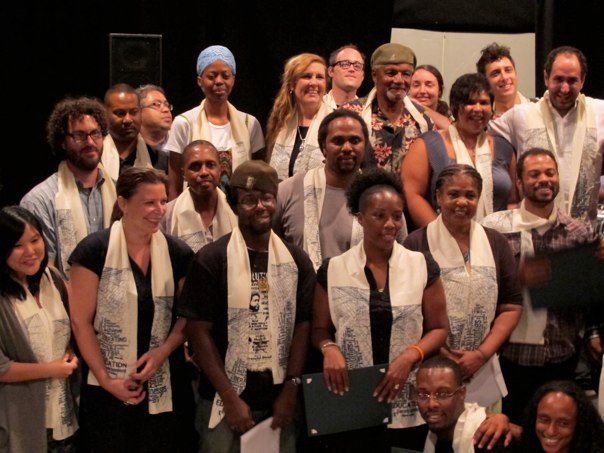
DETROIT – Over 30 Detroit residents became the first class of graduates from the Detroit Future Media Workshops last Saturday in the Allied Media Projects Theatre. In all, 34 community members completed a total of 22 weeks in advanced specialized media training followed workshops in entrepreneurship, education or community organizing with the overall goal of building a community media economy in the city.

Three-hour classes twice a week in video production, audio engineering, web and graphic design made up the first part of the coursework. Students then completed the second half of the coursework designed to compliment their current occupations or career goals related to education, entrepreneurship or community organizing. Graduates are now charged to pass on those skills in the various communities of Detroit to create jobs, foster cooperative economics and support community based media organizing.

“There were so many challenges setting up this program at such an accelerated pace and not having a precedence in setting up a program like this – especially with the class structure that we decided on,” said DFM Program Coordinator Joe Namy. “We knew we wanted to make the classes as diverse as possible – intergenerational and inclusive of a variety of skillsets and backgrounds. It’s very hard to keep such a diverse group engaged and committed, but in the end I feel like this was our biggest success. This is what made the program so rich. We allowed for a space where our elders and youth and everyone in between could interact and engage each other all around media.”

Completing the education track were Isaac Miller, Joseph Rodriguez Tanner, Martha Obringer, Matthew Cross, Jason Graves, Triana Kazaleh-Sirdenis, Michael Polk, Renee Newman, Jason Graves, Dr. Conja Wright, Sanaa Green and Vanden Spady. Completing the entrepreneurial track were Amos White, Dr. Angela D. Allen, Barry Thomas, Dr. Charles Simmons, Craig Peterson, Deleana Hill, Eddi Gonzales, Fernando Parraz, Jon Blount, Karen Gates, Lydia Debnar, Matthew Love, Nathaniel Mullen III, Piper Carter, Sean Thomas, Stanley Kirk, Tiwana Carmichael and Tonya Warren.

Graduates of the social justice track were Corey McCord, Paul Abowd, Moudu Boqui, Rhonda Anderson, Sarah Coffey and Patrick Ali. Of the 34 participants, some only completed the media portion of the training.
Instructors in the various courses were Janel Yamashiro (web/education), Imad Hassan (video/education), Ron Watters (graphics/entrepreneur), Darren Vaugh (audio), Marisol Teachworth (education), Diana Nucera (entrepreneur) and Jenny Lee (social justice).

“It takes a special kind of instructor to be able to facilitate this,” Namy said."Our instructors have all said they learned as much as the students throughout this process."

Local activist, Rich Feldman attended both the opening ceremony for DFM and the graduation. He reflected on the accomplishments of the program, saying, “As I watched people's faces (graduates, family and friends) and felt their enthusiasm, I remember the filled room in February or March when we were just inaugurating this historic initiative. The sense of pride, the sense of accomplishment, the commitment to each other, the critical connections, relationship born and nurtured, the visioning of community and a responsibility to define our collective future was all present. It was special hearing the words, the clapping, the energy while seeing the graduation scarfs as a symbol of birthing of another dream moving hopes into reality." 

Detroit Future Media is a program under the Detroit Digital Justice Coalition. The DDJC is comprised of people and organizations in Detroit who believe that communication is a fundamental human right and works to secure those rights through activities grounded in the digital justice principles of: access, participation, common ownership, and healthy communities.

Namy added that the DFM’s first graduating class is only the first step in the program’s work to build a better future rooted in the idea of uplifting the citizens of Detroit’s inner city communities.

"We're currently working on our in-school program, placing some of the DFM participants as teaching artists working with 12 teachers in Detroit, Hamtramck, and Highland Park. After this we will focus on our next round of workshops, which we expect to start around October/November. In the meantime we'll be having some additional community events, if people are interested in finding more about our programing they can email me and I can put them on our mailing list, joe@alliedmedia.org.

"We're also developing a web platform through which graduates of Detroit Future Media will have profiles and can market their curricula, trainings, goods and services to the wider Detroit community.  Keep checking detroitfuture.org to stay in touch with us."

Food Justice Taskforce debuts ‘Cook Eat Talk’ documentary and zine


DETROIT – Over 60 community members turned out to the historic Eastern Market on August 17 for the Detroit Food Justice Taskforce’s community screening of the “Cook Eat Talk” documentary and Cook Zine. Both the documentary and the brochure chronicle the work of the DFJT during the first-year planning phase of their work and leading up to a series of community engagement sessions aimed at addressing food security, sovereignty and justice issues in the future.
“I was very pleased with the number of folks that turned out – old faces and new,” said DFJT Administrator and EMEAC Associate Director Lottie Spady. “That really reflects the relationship building we’ve been doing over the past year and beyond.”
The screening was held at Shed No. 5 at Eastern Market. Community members enjoyed special food and beverages provided by DFJT Member, Peoples Kitchen Detroit. Peoples Kitchen also distributed copies of the latest Cook Eat Talk zine – version 3.0. The zine serves as a companion piece to the documentary and not only tells the story of the Food Justice Taskforce in words and stills from the documentary but also includes health conscious recipes from the community members and lists the 10 principles of food sovereignty.
“We wanted to share the story of the Food Justice Task Force and lift up some of the strategies that we’ve learned along the way,” said DFJT Coordinator Gregg Newsome of the Peoples Kitchen. “Cook Eat Talk is a community gathering facilitated and supported by Food Justice Task Force partners. Theses gatherings share a new strategy for mindful, respectful and mutually beneficial community engagement.
“For me, the emergent, non-prescribed format, was quite significant. I think that this was facilitated by our decision to embrace and celebrate each community’s invisible capital and honor their specific interests and self-identified needs.  Rather than entering communities with a cookie cutter program, Cook Eat Talk offers menus, choices and has a flexibility that communities and families need in order to establish a healthy relationship with food.”
Overall, DFJT members said they were pleased with the feedback from community members that attended the screening and look forward to the next phase of their work.
“I think they were received extremely well as seen by the number of peole that purchased zines,” Spady said. “We really wanted to make the zine assessable to everyone,
Some of the input that I got from the people that saw the documentary said that it brought the work to life better than a written report ever could. So, I was really pleased with how things went overall.
“Based on the community’s input gathered at each Cook Eat Talk session, the taskforce will be expanding into a network of community food justice hubs that will work on behalf of each community. We’re looking forward to that process and providing training and support to each of the local communities.”

Link to EMEAC Newsletter

July 18, 2011

<!-- BEGIN: Constant Contact Stylish Email Newsletter Form -->
<div align="center">
<div style="width:160px; background-color: #00CCFF;">
<form name="ccoptin" action="http://visitor.r20.constantcontact.com/d.jsp" target="_blank" method="post" style="margin-bottom:3;"><span style="background-color: #006699; float:right;margin-right:5;margin-top:3"><img src="https://imgssl.constantcontact.com/ui/images1/visitor/email1_trans.gif" alt="Email Newsletter icon, E-mail Newsletter icon, Email List icon, E-mail List icon" border="0"></span>
<font style="font-weight: bold; font-family:Arial; font-size:16px; color:#006699;">Sign up for our Email Newsletter</font>
<input type="text" name="ea" size="20" value="" style="font-family:Verdana,Geneva,Arial,Helvetica,sans-serif; font-size:10px; border:1px solid #999999;">
<input type="submit" name="go" value="GO" class="submit"  style="font-family:Verdana,Arial,Helvetica,sans-serif; font-size:10px;">
<input type="hidden" name="llr" value="rdr8btcab">
<input type="hidden" name="m" value="1102298596465">
<input type="hidden" name="p" value="oi">
</form>
</div>
</div>
<!-- END: Constant Contact Stylish Email Newsletter Form -->
<!-- BEGIN: SafeSubscribe -->
<div align="center" style="padding-top:5px;">
<img src="https://imgssl.constantcontact.com/ui/images1/safe_subscribe_logo.gif" border="0" width="168" height="14" alt=""/>
</div>
<!-- END: SafeSubscribe -->

<!-- BEGIN: Email Marketing you can trust -->
<div align="center" style="font-family:Arial,Helvetica,sans-serif;font-size:10px;color:#999999;">
For <a href="http://www.constantcontact.com/jmml/email-marketing.jsp" style="text-decoration:none;font-family:Arial,Helvetica,sans-serif;font-size:10px;color:#999999;" target="_blank">Email Marketing</a> you can trust
</div>
<!-- END: Email Marketing you can trust -->

DIT’s Ugliest School Yard project nears completion

July 17, 2011

The Greener Schools Program’s Ugliest School Yard Project at the Detroit Institute of Technology (DIT) is nearing completion thanks to the efforts of a group of DIT students, staff, parents and volunteers over the summer. DIT’s Ugliest School Yard Project involves the relandscaping of the school’s entrance and will be completed in August.
“The students decided to landscape their school entrance in hopes to set a more positive tone for the upcoming school year,” said EMEAC’s volunteer coordinator Kim Sherobi who works with the Greener Schools Program. “The particular design was developed by DIT students with the help of M'lis Bartlette, a landscape architect student from the University of Michigan.” 
Work began on the project during the school year as part of Greener Schools’ Ugliest School Yard Competition where EMEAC affiliated schools under take landscaping or gardening projects designed to enhance their school’s environment. Similar projects are underway at Norsoma Institute and Palmer Park Academy.
“The efforts of the project participants are going well,” Sherobi said. “At least 10 students have shown up to assist in the development of the project. Throughout the workday, everyone is making comments about how beautiful the design looks. Many drivers passing by have stop to make encouraging comments or give the thumbs up sign.
“Even the DPS police drive by as we are working and smile about our efforts and progress. The work days have given students and staff a chance to build stronger relationships. The teamwork and collaboration has been great.”
Sherobi thanked DIT principal Ms. Kovari and other staff members like Ms. Gligor, Ms. Scott, Ms. Wade and Coach Al for taking time to lend a hand and their commitment to seeing the project through.
“Special thanks should go out to the architect, M'Lis and her partner, Eric, for the guidance during the project,” Sherobi said. “Of course, to Lizzy for believing that the staff and students at DIT could complete the project. Let me not forget all the students, volunteers and any other staff members who helped.”

Peoples Water Board remains vigilant over water access issues in Detroit


DETROIT -- Detroit’s high number of water shut offs and the potential privatization of the city’s water system continue to be a major concern for the members of the Peoples Water Board whose mission is for:  access & affordability, protection, & conservation  and the water system to be remain in the public trust free from privatization in the City of Detroit.

“The biggest issue over all these past two years and going forward has been the overwhelming loss of access to water for residential use via thousands of shut offs and the failure of the City of Detroit to implement the original Water Affordability Plan of 2006,” said PWB member Charity Hicks. “There’s also the threat and push towards a hostile takeover of the people of the City of Detroit's water infrastructure system and privatize it, via state action.”

Despite a long-standing history of maintaining sole control of its own water system while operating as a municipal non-profit-enterprise agency  amidst persistent attempts by suburban interests, Detroit Mayor Dave Bing capitulated under the pressure of a well-orchestrated media campaign and political maneuvering to erode control of the city’s water system, which also services multiple outlying sprawling suburban communities. Although news of the future of the city’s water system has since disappeared from the headlines of the mainstream press, the People’s Water Board urges Detroiters to be vigilant on the issue so that Detroit’s water system doesn’t follow a growing trend among Rust Belt communities and move toward privatization.
“We knew it was coming because you can hear the chatter and the consistent privatizing and selling/transfer of Detroit assets,” Hicks said.

The Peoples Water Board Detroit started in 2009 from a series of meetings around access and affordability of water and pollution issues. The meetings were led by the Michigan Welfare Rights Organization (MWRO) and the Sierra Club Great Lakes Program. The meetings centered around water-quality and conservation issues. Local labor groups were also involved in looking at the significant privatizing of the local water system.
The coalition decided in the spring 2009 to conduct a series of organizing meetings to set up a "Peoples Water Board" to research, advocate, and movement build around various water issues in Detroit. The coalition also felt it necessary to watch and monitor the existing municipal water board serving at the pleasure of the Mayor of Detroit.  The People’s Water Board hopes to work with the Municipal Water Board of Commissioners to make our water affordable, fishable, swimmable, and kept safe in the public commons.

There are nine commissioners on the Peoples Water Board of Detroit and several  observers. Gwen Gaines and Ann Grimmett, both of MWRO, work on water access and affordability. Melissa Damasche of the Sierra Club’s Great Lakes Water Program-Detroit, and Derek Grigsby of the Green Party also serve working on pollution control and conservation. Andre Martin of MECAWI and John Rhiel of ASCME 207 serve representing water being held in the commons free from privatization. The three at large positions on the board are filled by Priscilla Dziubek of EMEAC, Lila Cabill of the Rosa Parks Institute and Hicks, who also is one of the founding members and current secretary for the Detroit Black Community Food Security Network.

The founding coalition members are: Sierra Club, MWRO, Rosa Parks Institute, AFSCME Local 207, Detroit Black Community Food Security Network, Michigan Emergency Committee Against War & Injustice, East Michigan Environmental Action Council, Detroit Green Party, and Matrix Theatre. Several persons, organizations and projects observe and work with the coalition in promoting awareness of water issues in Detroit. The newest group is Food & Water Watch has recently joined the coalition while several hundred individual supporters have signed on to the PWB mission statement.

“Water is life. The People’s Water Board advocates for access, protection, and conservation of water. We believe water is a human right and all people should have access to clean and affordable water. Water is a commons that should be held in the public trust free of privatization. The People’s Water Board promotes awareness of the interconnectedness of all people and resources.”

“We have conducted a film series in conjunction with Detroit Public Library to raise awareness on water issues, stenciled storm drain covers to remind residents not to dump, petitioned Municipal Water Board to stop all residential water shut offs, represented the coalition at 2010 U.S. Social Forum Peoples Movement Assembly,” Hicks said. “We want to cross pollinate movement building by attending gatherings to relationship build. We also blog to tell our story, conduct email campaigns and write letters to the editor to voice our coalition’s position.”

“We’ve met with congressional and state leadership on water issues such as pollution, and  infrastructure costs to learn about federal and state programs. We’ve toured the waste water treatment plant to understand our infrastructure needs and capacity while monitoring the permit process of DWSD. We’ve reviewed contracts, researched and reviewed the consent degree and federal over sight on DWSD. We’ve held a monthly informational picket at the monthly Municipal Water Board meetings, disseminated flyers and information. We’ve presented with Matrix Theatre on World Water Day 2009 with youth and community. We’ve held a poster contest for school children, tabled at River Days with the Friends of Belle Isle and other significant and powerful work. Over the past two years we hope we have raised awareness, engaged citizens and policy makers, and called the question on DWSD for greater transparency, democracy, and improvement in the quality of life of residents.”  For more information on the Peoples Water Board Detroit, visit: http://www.peopleswaterboard.blogspot.com/

Octavia Butler and The Movement explored at AMC workshop

By Adrienne M. Brown

Octavia Butler
At the 2011 Allied Media Conference there was an entire track on Science Fiction and Movement which had a lot of relevant content for an organization like the East Michigan Environmental Action Council. I want to share the planning notes of the Octavia Butler and Emergent Strategy session, which is in some ways inspired by the deep work EMEAC does. Enjoy!
Opening Thoughts:
The most successful strategies in black science fiction writer/prophet Octavia Butler’s books are emergent strategies – meaning the characters are themselves shifting conditions, or caught in shifting conditions, that allow new possibilities for their evolutionary work. Within that shifting work, they are emerging new strategies.
"Strategy is a word of military origin, referring to a plan of action designed to achieve a particular goal. Strategy is a comprehensive way to try to pursue political ends, including the threat or actual use of force, in a dialectic of wills – there have to be at least two sides to a conflict. These sides interact, and thus a Strategy will rarely be successful if it shows no adaptability.” - Wikipedia

In the organizing/non-profit world we currently live in, we are constantly encouraged to define strategy in the terms of the status quo. 
As an organizational healer, I often see folks who want to make a change or impact on the world fall short the moment they try to become strategic. Though they might be trying to create a new world within the main space of their organizing, more often, I see groups fall into the familiar, functioning in a way that is counter to the values they espouse.
To begin anew in terms of organizational development and strategic planning, i think we need to first come up with our own definition for strategy: Think of the strategic plans, the strategies you see in the movement work…how would WE (who are seen as not strategic BECAUSE we are emergent) define strategic?
One key seems to be the ability to engage in emergent strategies.
Emergent Strategies in Octavia Butler:
"Emergence is the way complex systems and patterns arise out of a multiplicity of relatively simple interactions." - Dictionary.com
Instead of all of our work being focused on an end goal, a win, we need to see our strategy as a constantly emerging process where we apply lessons and advance our values and principles in our actions. For me, Butler's work gives us several examples of this type of strategy in practice.  
In the Parables Series, the main character (Lauren) has to devise a new strategy after her post-apocalyptic intentional community is decimated by the futuristic radical right wing. Lauren is holding a spiritual vision, not just a political one. She ends up going door to door to share her vision, her philosophies. I think about this story a lot when I hear organizations tending towards institution building. Do you understand the philosophy you are trying to advance, and are you flexible enough to focus on the philosophy instead of the structure. In this instance, the emergent strategies are relationship building; taking whoever comes - seeing each person, regardless of class, race, ability, gender, sexuality, as a potential revolutionary; focusing on being philosophically/spiritually rooted as opposed to institution building.
I think the Xenogenesis series is the ultimate emergence book. Lead character Lilith wakes up all alone in an alien world, and becomes a leader in the process of evolving humanity by integrating with another species. As she goes through the process of figuring out her survival, it becomes more and more clear that the alien Oankali have power and they are the ones integrating her, and other humans, into their existence. Lilith has an immense capacity for grief and loss, and being alone (having already lost her family on earth). The strategies in this collection are Lilith's emergent learning and adaptation based on survival instinct - having survived makes you the strongest possible next leader.
This reminds me of one of the principles of Allied Media Projects, EMEAC's partner in Detroit Future Media: “The most effective strategies for us are the ones that work in situations of scarce resources and intersecting systems of oppression because those solutions tend to be the most holistic and sustainable.”
Perhaps most relevant to us is the strategy that brings the downfall of the evil body snatcher Doro in the Patternist series. His daughter Mary is able to conquer him by working with the full interconnected network of telepaths who have developed the capacity to flow all of their individual smaller energies together to bring down one massive oppressive and deadly opponent.  Doro underestimates them because he cannot even understand what they are doing. The emergent strategy here is collective organizing with trust – Doro lost because he couldn’t be a part of the collective or the whole. The other strategy was clear understanding of the necessary roles – understanding the nodes who could connect the network, and who had enough energy to be drawn upon.
In the Patternist series, the revolution/counter-revolution is very present: within two books the liberated network of telepaths have evolved into the oppressive patternmasters – oppressing humans, who they call ‘mutes’ and battling a new human hybrid species created by an alien disease. The new species becomes the revolutionary force in the wild, an organic force that primarily exists in their bodies, not their minds.
So if we think of emergent strategy as intentional, strong because it is decentralized, adaptive, interdependent, and creating more possibility, rather than coming to a victorious end, it changes the way we approach our organizing. 
Discussion:
The participants had several rounds of conversation to explore these ideas, around prompts such as:
- what would change if we applied these strategies to our current organizing?
- what would be the indicators of excellent emergent work in organizing?
- how would we evaluate emergent leaders?
- in a world where we focus on emergence, how do plans serve us? 
We openly discussed how shifting away from long-term inflexible plans, and into long-term strategic intentions & aligned principles where we determine our next moves by reflecting. 
Each participant was then asked to make a commitment to shifting into emergent strategy in their own work and life. 
EMEAC is already doing this kind of thinking or and organizing. We invite you to join us. 

Phase II of EMEAC Sumer Camp gets underway

Kim Sherobi of Greener Schools and Maria Ryen of
ReMedia do an exercise with youth during Phase I of
EMEAC's GAME Summer Camp in June

The second part of EMEAC’s first in-house summer camp gets underway July 18 in McCallister Hall of the First Unitarian Universalist Church as approximately a dozen Detroit youth will receive intensive leadership development during Phase II of the Gardening Activism Media and Education Sumer Camp. 
Phase I of the GAME Summer Camp concluded last month as a similar number of youth attended the 2011 Allied Media Conference and enjoyed several other environmental and media justice activities under EMEAC’s Stand Up Speak Out program. Phase II will be conducted by EMEAC’s ReMedia Program and will continue for six weeks through August 26.
“The Stand Up Speak Out team did a great job kicking things off last month and we’re really looking forward to trying to build on that for Phase II of GAME,” said ReMedia Coordinator Patrick Geans-Ali. “I was so impressed with the young people that participated in Phase I. All of them seemed to be young people that will make a difference in their communities going forward.
“I’m sure we’ll get a similar group for phase II and I’m excited seeing how they respond to the curriculum we’ve got in store for them.”
The second phase of GAME with the theme “Grow Your Own Media” will focus on developing campers’ leadership skills and educating the community around food justice issues like the U.S. Farm Bill 2012. Campers will be taught how to participate in and facilitate workshops on environmental, food and media justice issues before conducting a series of Cook Eat Talk sessions at the Detroit Science Center and Children’s Museum, Vangaurd CDC, Earth Works Capuchin Soup Kitchen and EMEAC with the Detroit Future Media Youth Network.
Phase II of GAME will also follow up on Phase I projects and activities like the Environmental Justice Tour with the Detroit Sierra Club and producing a film project based on Phase I activities at the Allied Media Conference. Other activities include development of the North End Community Garden, Biking expeditions with Sarah Sidewalk's Fender Benders, Niche market food entrepreneur training with Can-Did Revolution and an opportunity to be involved in the production of a music video with Detroit MC Kadiri Senefer and get first hand instruction from some of Detroit's most accomplished independent media makers Kodjo Vaden and Alecia Becks.
“Lottie and I really feel it’s important that campers get an opportunity to get some real hands-on learning while developing their leadership skills. At the same time, we want the kids to have fun in the process and that all these things go together.
“We’re hoping the young people come away from the camp having really picked up some valuable knowledge, skills and experience and then be ready to take those things they’ve acquired and use them going forward to uplift the community. If we can do that and have fun at the same time, it will be a success.”

Allied Media Conference 2011 another big hit for Detroit

By DMEC Communicator

Attendees to a workshop at the
2011 Allied Media Conference
The 2011 Allied Media Conference wrapped up yet another fabulous conference in June.  Highlights at this years conference included cooking workshops, a how to build a radio series, the addition of an entire dance track, and the expansion of the child care track.
But the thing that makes the Allied Media Conference special and different than other conferences is the emphasis on organizing being done in Detroit by Detroiters. This year's line-up of Detroiters included workshops designed to show connections between environmental justice and media justice, bus tours of the computer centers created by the Detroit Digital Justice Coalition (DDJC), and a Digital Justice Coalition meet up of digital justice organizations from across the country.
This year's AMC also saw the culmination of work started by the DDJC at the AMC two years ago. The Detroit Media Economy Collaborative (a project of the DDJC) saw two of its three programs (Detroit Future Media and Detroit Future Media Youth Network) start up in the first half of this year, and both programs had a presence at the AMC.
Future Media students from all four classes (graphic design, web, audio, video) led a skill share lab where conference attendees learned how to manipulate photos using computer software, shoot video, record beats and create websites.
Instructors for the Future Media program presented at a workshop that highlighted multiple ways to use popular education in the classroom. Detroit Future Media students from the graphic design class also demonstrated their entrepreneurial skills by selling several of the t-shirts they designed.
The Detroit Future Media Youth Network also made its debut, holding a workshop on networking that was standing room only (see here for more details).
The most exciting aspect of the AMC, is as usual, the energy of the participants. Seeing workshops on networking in Detroit crowded with people eager and willing to make change supports what organizers in Detroit have been saying for a long time: Detroit is actually rich in resources and more than capable of creating the changes it needs. As conference attendee, Mandy Van Deven states, (http://www.alternet.org/vision/151487/who_says_media_is_dead_5_takeaways_from_progressive_journalists_and_activists_at_the_allied_media_conference?page=entire) “Anyone lamenting conventional media’s expiration would do well to attend the summer conference and experience firsthand the excitement of a metaphorical phoenix rising from the ash.”

Eco Media Justice Track at AMC 2011 provides good food and feelings

AMC 2011 goers enjoy the Field to Ford dinner at
Spaulding Court


 The Eco Media Justice Track at the 2011 Allied Media Conference featuring an Environmental Justice Tour by the Detroit Sierra Club and a Field to Fork Dinner was another big success in its second year. The track began with on the second day of the AMC with a filled-to-capacity Environmental Justice Tour and a Field to Fork Dinner at Spaulding Court featuring the Green Guerillas out of Ithica, New York.
This is my 5th year of involvement with the Allied Media Conference and have been amazed and pleased by its growth each year,” said EMEAC Associate Director Lottie Spady. “Not only was it the type of media organizing that is represented, but the holistic approach to justice work that is increasing its presence each year. This was the second year that the AMC featured an Eco-Justice Media Track and the first which specifically focused on food justice.”
The Sierra Club’s EJ Tour drew so many people that a significant number had to be turned away as a 50 passenger bus and two 15 passenger vans could not accommodate all the people wishing to attend the tour. The Sierra Club’s Rhonda Anderson, Spady and EMEAC Stand Up Speak Out Youth Leader Siwatu Salama-Ra each guided AMC attendees on the tour which visited the Detroit Incinerator, the condemned Michigan Central Train Station, the incomplete Ambassador Bridge and the industrial corridor of Southwest Detroit, which is home to several environmentally hazardous industries such as the Marathon Oil tarsands refinery, Great Lakes Steel, Severstal Steel, the Detroit Salt Mines, the Detorit Waste Water Treatment Plant and others.
Rhonda Anderson of Detroit Sierra Club's EJ Office speaks
to tour goers in Southwest Detroit  neighborhood
During the tour the buses stopped at a residential neighborhood particularly hard hit by pollution in the area before returning to AMC to close the tour with a healing circle conducted by the Sierra Club’s Michelle Martinez.
I thought the tour went very well,” said Anderson. “I regret we weren’t able to include all the areas we wanted to go to but the places we did visit were very poignant and impressionable on the participants.
“I think the opportunity to get off the bus and discuss what we were seeing was really good too. I also thin the healing circle to end it was excellent. After seeing so many negative things in the fight for environmental justice in Detroit people need something to lift their spirits and Michelle did a great job.”
The second day of the Eco-Media Justice Track saw approximately 50 people travel over to Spaulding Court where they enjoyed a tour of Brother Nature Farms by Greg Willerer before sitting down to a wholesome vegetarian dinner prepared by Chef Whitewater of New Mexico and Angela Newsome of the Peoples Kitchen of Detroit. During dinner attendees were treated to music powered by the Green Guerillas bio-diesel bus and an open mic poetry session.
Angela Newsom of People's Kitchen prepares dinner at
the AMC 2011 Field to Fork dinner
“I do think we are on to something with the Field to Fork Dinner and Open Lens/Mic Night though,” Spady said. “This year, in addition to the environmental justice tour that kicks off the Eco-Justice Media track, we had a youth food justice dinner at Spaulding Court featuring an interactive cooking demonstration by Chef Whitewater of Red Mesa Cuisine and Angela Newsom of the People's Kitchen Detroit.
“We saw firsthand where our food comes from with the tour of Brother Nature’s Farm then closed with a teen open mic with poetry and song. I am still hearing rave review of this event and the only challenges with it I see in the future will be how to accommodate the growing number of interested participants.”
Looking forward, Spady says EMEAC’s ReMedia program which she also directs is very much looking forward to future installments of the Eco-Media Justice track at future AMC’s.
“There were plenty of challenges in that we are national committee working largely via conference call to pull all of the details together,” she said. “There are always lessons to be learned around how to plan and prepare more effectively so things run smoothly, and ways to make it a more substantial yet enjoyable event for the youth.  
Leslie Jones of the Green Guerillas gives a tour of the GG's
bio-diesel, solar-powered mobile media lab. 
“I feel like we are really working to include the principles of environmental justice in the AMC and will continue to look for ways to challenge ourselves in this area. We are also mindful of how our activities can leave resources in the community that last beyond the conference. Next year we anticipate activities such as a composting toilet build and we hope to move the AMC into more of a zero-waste event.”
Leslie Jones of the Green Guerillas said she was also glad to see interest in the Eco-Media track grow so much in only its second year. Jones says that stretching the experience beyond the walls of the base of the AMC at Wayne State and moving out into the community could be a major reason why attendees are showing so much interest. 
"This is the second year that Green Guerrillas Youth Media Tech Collective both attended the AMC and worked with EMEAC to coordinate the eco-justice track," Jones said. "We subtitled the track Survival & Sustainability this year because we are steadily encouraging everyone to connect the dots between environmental justice, social justice, and all the other movements in between that challenge the status quo by promoting people over profits, relationships over isolation, and health over
"We experienced a growing interest in our track this year, receiving positive feedback from both the eco-justice tour of Detroit and the teen farm-to-fork dinner open mic/lens field trip. With the support of AMC, we were able to offer conference participants a unique opportunity to go beyond the four walls of Wayne State and connect with the local community in real time on real issues with real talk."
Jones added that the Green Guerillas and ReMedia look forward to the challenge of breaking new ground at AMC 2012. 
"We definitely want to continue to grow hands-on opportunities for participants to connect to eco-justice principles in their own lives," she said. "One of the things we are looking forward to for AMC2012 is a compost toilet community build to benefit Brother Nature's Farm (so he can host dinners like ours) and D-Town Farm (so they can save on porta-potty rental fees). This year we focused on food justice to promote the radical notion that we are what we eat. Additionally, our dinner was a zero-waste event. We did not even have a trash bag on hand! Next year, we want to take the conversation even further to raise awareness around resource use and waste. If we need to better understand where our food comes from, then we certainly need to be more cognizant of our waste stream. You cannot have one without the other. Connecting the dots, balancing the issues, moving past comfortable conversations, shifting our consciousness... AMC2012, here we come!"

DFM Youth Program holds first activity at AMC

By DMEC Communicator


DFM Youth Coordinators Ilana Weaver and Alia Harvey
speak with youth groups at 2011 AMC 
Detroit Future Media Youth Program's first open event was a co-facilitated workshop on Friday, June 24th at the 2011 Allied Media Conference (AMC). This session illuminated the interconnected ecosystem of Detroit and Highland Park's youth media and social justice programs and organizations. The science fair format allowed for each group to present the main hypothesis of their work and show the experimental and innovative ways they are applying them for their community's needs and visions.
Rather than volcanoes shooting baking soda lava, and science fair style display boards, each group facilitated a short interactive workshop activity. The network showcased its efforts to cross-pollinate youth social justice and media grassroots efforts and to shift from youth service, to youth led activism and organizing. Youth from the Detroit area and beyond showed up and packed the room. 
The Detroit Future Media Youth Program presented an interactive workshop on the value of creating a network.
The Michigan Roundtable  and Detroit Asian Youth Project highlighted the importance of open dialogue in transformation work through an interactive exercise that included the use of social media and small group discussion.
Capuchin Earth Works and Capuchin Rosa Parks programs worked together to break down Detroit's food system. Volunteers from the audience formed a human knot that represented different aspects of the food system. The volunteers worked together to untangle the food system.
Detroit youth attending the DFM Youth Program's
workshop at 2011 Allied Media Conference
Urban Neighborhood Initiative's Real Media and East Michigan Environmental Council's Remedia program facilitated a short interactive storyboarding activity.  Audience members created a storyboard for a film of their own creation, while watching video clips of finished products.
Vanguard Community Development Corporation’s Young Social Entrepreneur Society and Young Nation partnered on an interactive activity in which audience members worked together to create individual tiles that turned into a small mural.
Five Elements Gallery, The Heru and Detroit Impact lead an exercise that demonstrated how to use basic media skills to make a profit while benefiting the community. Volunteers for this activity designed t-shirts and advertised using social media.
Detroit Summer and Ruth Ellis Center's Out and Upfront program closed out the session with an interactive workshop about how interviews of community members can be a useful tool in designing community organizing projects.
This interactive, youth led workshop would not have been complete without a young DJ spinning between each activity.

Perrin’s legacy key to shaping EMEAC’s past and future

Like many truly great individuals, the life and work of the late Dr. Eugene V. Perrin positively influenced a wide array of people and organizations. The East Michigan Environmental Action Council is humbled to be one of them.
In addition to being a renowned anti-war activist, philanthropist, college professor, World War II veteran, founder of the Nobel Peace Prize winning International Physicians for Preventnion of Nuclear War and a pioneer in researching uses of the human placenta among numerous other things, Dr. Perrin was also a long-time member of the EMEAC Board of Directors. There he helped shaped EMEAC’s scope beyond just environmental protectionism into the sphere of environmental justice.
Dr. Gene Perrin was one of EMEAC's founding members and he was still a member of the EMEAC board when I came on as executive director,” said EMEAC Executive Director Diana Copeland who was brought on to guide EMEAC’s work into a more environmental justice framework. “I remember him as extremely friendly, very interesting and interested in so many things.  He always had colorful political buttons covering his shirt, and he had a van to match, with political bumper stickers covering the entire back of the van, which he often used to help us move around recycling.”
Following his passing in May, Dr. Perrin’s memorial service held at the First Universalist Unitarian Church was attended by such distinguished public servants such as U.S. Congressman Hansen Clarke, Helen Weber of Peace Action of Michigan, Ralph Simpson of the America Civil Liberties Union of Michigan, and a special message from Congressman John Conyers. During that service, Perrin’s life work in human rights, peace activism, medicine and civil liberties was remembered in a special eulogy by First UU Pastor, Reverend Bill Neely and person reflections from his first wife, Dr. Jane Perrin, his children and grandchildren.
During his final days, Perrin learned that the First UU Building complex was about to be donated in perpetuity to EMEAC for the creation of a Cass Community Commons Space where like-minded organizations and businesses can pursue their goals of transforming community based on social justice models.
“He was in the hospital when he heard that the historic Unitarian Church and adjacent mansion had been donated to EMEAC and he and his partner (Linda Darga) said they just could not have been happier about the decision,” Copeland said. “I believe that the Community Commons that EMEAC and partners are creating in that historic space will be, if not already is, part of Dr. Perrin's legacy.  He was so passionate about all justice issues and how they cross over.  I really feel that is the essence of the Commons space.”
Perrin migrated with his parents Frances (Fannie) Levin and father Emanuel Paperno migrated from Kharkov, Ukraine in the early 20th century. After completing high school in 1944 age 16, Eugene served in the US Army 1944-45 excelling in Japanese language at Yale University. He graduated from Wayne State University 1949 and University of Michigan School of Medicine in 1953. He went on to become certified in anatomic pathology following residencies in Boston and New York.
He later went on to teach in the field of pathology at the University of Cincinnati, Case Western Reserve, and Wayne State University. There he was Professor of Pathology, adjunct professor of Anthropology. He was a founder of Society Pediatric Pathology, Charter Member Teratology Society.
Although he was a WWII veteran, Perrin was an anti-war activist and local founder of Physicians for Social Responsibility. He also became a member International Physicians for Prevention of Nuclear War, which received of the Nobel Peace Prize 1985. Perrin also found time to become an environmental activist and teacher. He studied environmental engineering, biology, medicine , clinical genetics and became a member of the International Joint Commission and East Michigan Environmental Action Council.